
ADHD vs Autism. Ever wondered about the difference between these neurodevelopmental conditions?
Well, you’re not alone. Today, we’re going to dive into these two unique neurotypes and examine their similarities and differences. Further, we’ll talk about how we can support our neurodivergent loved ones, whether ADHD, Autistic, or both.

This post may contain affiliate links. As an Amazon Associate, I may earn a nominal fee from qualifying purchases. Thank you for your support. See my disclosure policy for more info.
Let’s Talk ADHD
ADHD (attention deficit hyperactivity disorder) is a unique neurotype that impacts the way one receives and processes the world around them.
Under the medical paradigm, ADHD is considered the most common neurodevelopmental disorder primarily related to challenges with executive functioning. It’s believed that brain development, specifically in the prefrontal cortex (PFC), is delayed in those with ADHD.
The PFC is the area responsible for those executive function skills. Further, when seeking an ADHD diagnosis, it’s important to know that ADHD is defined as one of three types of ADHD.
- Inattentive Type ADHD
- Hyperactive-Impulsive Type ADHD
- Combined Type ADHD
As there is no medical test for ADHD, medical professionals follow diagnostic criteria laid out by the DSM-V.

ADHD Signs and Symptoms
Symptoms of ADHD fall under the umbrella of each sub-type.
- Inattentive (formally labeled ADD)
- difficulties paying attention
- careless mistakes (these are not “careless” when you understand the reason behind the errors)
- challenges processing language
- difficulties with organization
- sustained attention is difficult
- Hyperactivity and Impulsivity
- fidgets, taps
- as if driven by a motor
- trouble sitting
- Interrupts
- impulse control issues
- Combined Type
- combination of the above signs
In the end, ADHD symptoms will typically fall under multiple ADHD category subtypes. Even more, these ADHD symptoms, particularly executive functioning difficulties, are seen in Autistic individuals as well.
Let’s Talk Autism
Within the modern medical framework, autism, like ADHD, is considered one of many neurodevelopmental disorders.
As with ADHD, to get a correct diagnosis, autistic people must work within the current paradigm.
According to the Mayo Clinic,
Autism spectrum disorder is a condition related to brain development that impacts how a person perceives and socializes with others, causing problems in social interaction and communication.
However, according to Reframing Autism, an autistic-led advocacy group of autism experts,
Autism is a brain difference that is basic and fundamental to who we are…
Autistic people develop differently to non-autistic people. Autistic individuals think, move, interact, sense and process differently to what people might expect and have qualities that make us like other Autistic people.
In the end, if you suspect that you or your child is autistic, diagnosis can help open doors to support services needed to function in a non-autistic world.
Autism Signs and Symptoms
When pursuing an autism diagnosis, doctors look for the following signs of autism.
- Differences in social communication
- General speech and communication difficulties
- Repetitive behaviors
- Laser-focused special interests
- Unique sensory experiences
Specific to social communication, neurotypical people have difficulties understanding the social cues of autistic individuals and vice-versa.
For example, for many autistic children and adults, eye contact is not part of their social interaction.
Additionally, autistic and non-autistic people have different ways of processing sensory input.
In a neurotypical world, school environments are often designed in ways that lead to sensory overload in autistic children.
What appears to be a behavioral outburst in an autistic child is often a natural response to intense sensory distress.
ADHD vs Autism: Pathology vs Diversity
Within the current medical model of the United States, both ADHD and autism are considered neurodevelopmental disorders. Unfortunately, this has led to stigma and harm.
Fortunately, that narrative is changing. Culturally, there’s been a push to broaden the narrow view of human experience.
Within this model of inclusion and neurodiversity, when comparing ADHD vs autism, they’re valued as two unique neurotypes.
This means that the ADHD brain and the autistic brain experience the world in ways that are often different from neurotypical people.
Limitations of the DSM
However, it’s important to note that to get a diagnosis for either neurotypes, parents, and adults must work within the medical model.
As such, doctors use diagnostic criteria as it appears in the DSM-V (Diagnostic Statistical Manual of Mental Disorders). The DSM is a tool produced by the American Psychiatric Association that changes every 5-7 years.
It’s not set in stone.
For example, the term ADD, attention deficit disorder, no longer exists under the DMS-V as all three subtypes are now labeled attention-deficit hyperactivity disorder.
Additionally, it wasn’t until the most recent update that a dual diagnosis of both ADHD and autism was even permitted.
While a helpful tool, it’s not without flaws as it’s influenced by human perception, politics, and the financial support of powerful organizations. Use it wisely with open eyes.
ADHD vs Autism: The Overlap
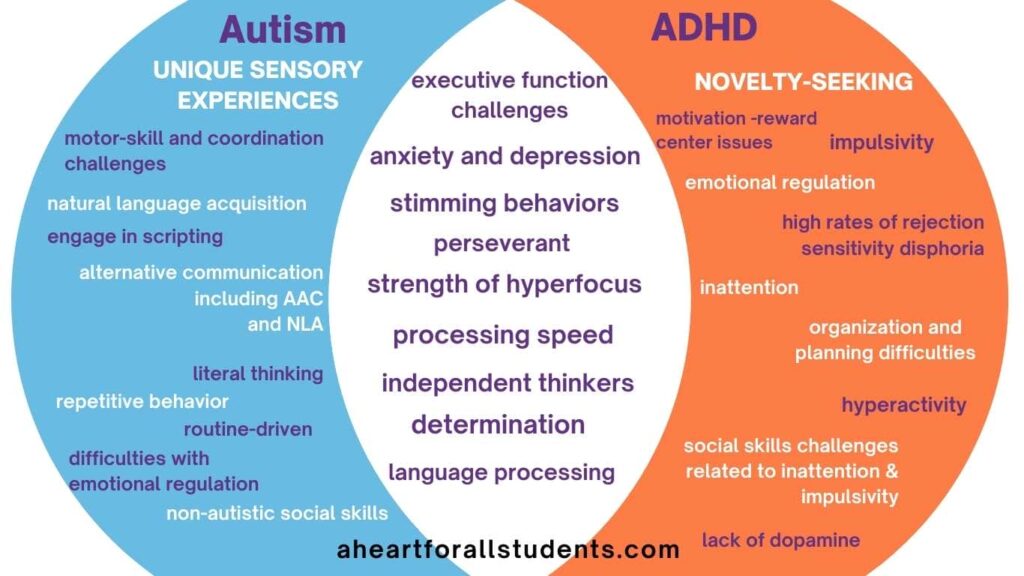
ADHD and Autism are considered two distinct conditions. However, they do share similar symptoms.
The following behaviors and mental processes can be seen in both autism and ADHD.
- Executive functioning delays
- Challenges with neuro-typical communication skills
- Difficulties with nonverbal communication
- Social difficulties
- Emotional regulation challenges
- Sensory processing challenges
It’s important to note that these symptoms and signs are not limited to ADHD and autism.
People with no diagnosis can also have challenges in any combination of these areas at different times.
Co-Occurring Conditions
Recent research suggests that 50-70% of those with an autism diagnosis have an additional (co-morbid) ADHD diagnosis.
On the other hand, we see autism in 20-50% of those with ADHD. Dr. Russell Barkley suggests that the rate of autism in someone with ADHD is closer to 20%.
Further, he describes the relationship as a “one-way co-morbidity.”
OCD, autism, and tourette’s are occuring at much lower brain levels. When they develop, they echo up and affect things above them like the executive system.
To clarify, the brain develops and functions from the bottom up. Autism is correlated with structures lower in the brain which then impacts the areas above it.
Again, in ADHD, we see challenges associated with the upper part of the brain or the prefrontal cortex.
Heritability and Family Connections
When comparing ADHD vs autism, we also see a high heritability rate among both. Specifically, there’s an increased likelihood of multiple family members identifying as autistic or ADHD.
Additionally, a 2017 study found that family members of autistic individuals had an increased likelihood of ADHD.
The researchers concluded that there may be a genetic relationship between ADHD and autism, but that further research is needed.
Executive Function Overlap
Executive functioning challenges and delays are seen in both ADHD and autism.
At this time, the reasons behind the co-occurring traits haven’t been fully established.
Let’s dive into this essential area of development to better understand its relevance to both ADHD and autism.
What are Executive Functions?
Executive functioning is related to a set of skills that allow a person to responsibly execute the various functions of daily life.
These skills can be thought of in terms of a conductor of the orchestra. Without the conductor guiding the musicians, the flutist can be a virtuoso, but no one will hear it because of the chaos.
Executive functioning allows one to harmonize strengths to function well.
Depending on the professional, executive functioning skills are broken down into a varying number of sub-types. Russell Barkley’s framework is based on seven executive functions which we will discuss today.
Again, these skills are housed in the prefrontal cortex and involve the following areas.
- Self-Awareness
- Inhibition
- Non-Verbal Working Memory
- Verbal Working Memory
- Emotional Self-Regulation
- Self-Motivation
- Planning & Problem Solving
One study looked at areas of executive functioning in autism and ADHD. Researchers found motor response inhibition was a common symptom in both autistic and ADHD participants.
Additionally, both conditions can comprise a combination of difficulties in each of or just one of the areas.
Further, the ways executive function difficulties present in an autistic child may be different or for different reasons than someone with ADHD.
Because that was as clear as mud, let’s look at a specific executive function challenge as an example.
Specifically, let’s look at the common issue or distractibility and inattention and how it can be rooted in different needs.
ADHD vs Autism: Focus
In ADHD and autism, the root issue behind attention issues appears to be distinct from one another.
ADHD is primarily linked to challenges with the dopamine reward system of the brain and delayed development in the prefrontal cortex.
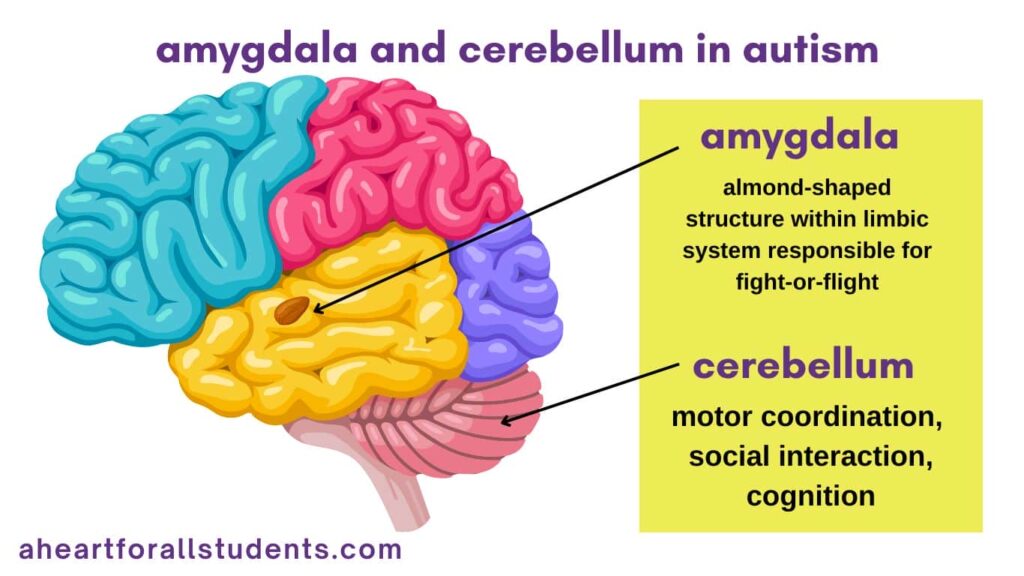
As we heard earlier, autism is linked to differences in the lower brain including the cerebellum and amygdala.
Inattention in Autism
An autistic child with inattention challenges may be experiencing overwhelming anxiety related to school bullying (fight or flight).
That same inattention may be rooted in the child struggling with sensory overwhelm.
Inattention in ADHD
A child with ADHD, on the other hand, struggles with focus because of a lack of dopamine.
Another ADHD friend may have inattention issues related to deficits in working memory.
Truthfully, it’s difficult to tease through which areas of struggle lead to which symptoms.
Inattention in Both
In the end, the exact reasons an autistic child may struggle could be the same reasons as a child with ADHD.
That’s why it’s important to look for root issues behind the behavior.
Regardless of diagnosis, when adults slow down and offer compassion, we’re better able to address root issues so kids can move forward.
Sensory Processing
Sensory processing difficulties, such as those observed in autism, impact behavior, emotional regulation, and attention.
These are all areas known to be troublesome for kids with ADHD. Additionally, we know that sensory sensitivities are common in ADHD as well.
Social Difficulties
Those with ADHD, as well as autistic children and adults, may have challenges in social interactions for completely different reasons.
Social Challenges in ADHD
An ADHD child may appear to have poor social skills related to impulsivity.
She may have challenges with verbal working memory which, when combined with a lack of inhibitory control, causes her to break neurotypical social rules.
Her impulsive behaviors may look like blurting out comments or interrupting other children which leads to rejection.
Social Challenges in Autism
On the other hand, an autistic child may run into social traffic jams with non-autistic children who don’t understand autistic social communication.
The autistic child, in an effort to connect with another child on the playground, may passionately share their special interest in Pokeman cards.
That child may not catch the non-autistic social cues of his audience.
Nuances of Socialization for All
While both ADHD and autistic kids can have similar social struggles, the root issues may be completely different.
In the end, however, any child having a hard time navigating the social world of the majority culture needs support.
This could look like broadening our educational and social climate to promote true inclusion rather than “tolerance”.
Teaching young children how to connect with people of different neurotypes can make such a difference for the minority group.
Language Skills
It’s not uncommon for neurodivergent thinkers to have challenges with speech and language skills.
Even when children appear fluent in speech, they often struggle with processing or language comprehension.
From the outside, this can look like willful disobedience to parents and teachers.
And within a social context, this means neurodivergent kids (ADHD and autism) may misunderstand the rules of a game or the nuances of conversation.
If you suspect speech or language difficulties, it’s important to have your child supported by a PRIVATE speech-language pathologist.
Structure and Pushing Boundaries
It’s a commonly-held belief that autistic individuals thrive on routine and structure. And while that may be true for some, it’s not always the case.
Additionally, we know that those with ADHD struggle to maintain organization and structure.
This could be explained by one of the strengths of both ADHD and autism. Creativity and perception.
In ADHD, an ability to see things differently, and the willingness to try new approaches lead to ingenuity.
Independent-Thinkers
On the other hand, many autistic children and adults are blessed with an independent nature that allows them to pursue their goals.
Unfortunately, they’re often labeled oppositional or defiant when they display this nature. This is tragic as independent thinkers change the world for good.
Yes, it’s extremely common in both autism and ADHD for children to resist outwardly imposed structure.
This is why I highly recommend parents and educators allow these kids agency and independence so they can thrive as learners.
Related Post:
ADHD vs Autism: Hyperfocus
Autistic and ADHD kids and adults are often gifted with the ability to hyperfocus on an area of intense interest.
When allowed to do this, children and adults can make incredible discoveries.
Mood Disorders
Unfortunately, mood disorders such as depression are correlated with both ADHD and autism.
One study estimates that up to 40% of children with ADHD have a depressive episode before the age of 30. Compared with the general population of around 25%.
Sadly, the data looks even more discouraging for autistic people.
Neurodivergent people living in an unforgiving neurotypical world result in traumatizing lived experiences.
Factors contributing to the mental health statistics of neurodivergent people include:
- chronic stress
- environmental factors such as hostile work and school environments
- bullying (by peers and teachers)
These are just a few factors contributing to the marginalization of autistic and other neurodivergent children and adults.
Parents of children with ADHD or autistic children, need to be aware of these dangers to support their child’s long-term well-being.
Support Services and Treatment
There are a number of different support services available to help both autistic and ADHD kids and adults thrive as themselves.
First and foremost, it’s important to develop the mindset of creating a team for you and your neurodivergent child. As a parent, you’re the leader.
Seek out strengths-based neurodiversity-affirming therapists and medical professionals to join your team. If they don’t want your input, fire them and find another one.
Some critical members of your support team include:
Speech Language Pathologist
A private speech-language pathologist is an excellent resource to help your child with communication challenges.
Speech therapy done well can be a game changer. SLPs can help with speech delays, disorders, and language-based learning disabilities such as dyslexia.
Related Post:
Occupational Therapist
Again, a PRIVATE occupational therapist can help with a number of different challenges that your child may be facing.
Occupational therapy can support:
- sensory integration therapy,
- reflex integration,
- eye tracking and convergence,
- emotional regulation support,
- gross and fine motor movements,
- and more.
Trauma-Informed Mental Health Professional
Children who are neurodivergent are at increased risk for a number of mental health challenges related to how they’re treated by the majority population.
Shame, rejection, social isolation, living in a world that nit-picks everything you do and say because it’s different.
This is dangerous.
A trauma-informed therapist will be able to support your child to work through unhealthy messages. Look into EMDR therapy as it works to support even those who have trouble articulating their thoughts.
Other Professionals
There are other support professionals you’ll likely need on your team.
Those include your child’s pediatrician, a developmental pediatrician, and possibly an adolescent psychiatrist for medication management.
Autistic Role Models: Adult Autistic Community
Autistic adults and other neurodivergent people are now collaborating in large numbers to get their voices heard. Historically, autistic voices have been left out of the conversation regarding their treatment and care.
Specifically, they’re seeking to end the stigma. For example, within the autistic community, affirming language is preferred.
- An autistic person rather than a “person with autism”
- Autism traits vs “symptoms of autism”
- Autistic rather than ASD
In the end, it’s important to listen to the voices of real autism experts, those with lived experience.
Strengths-Based Resources for Parents
Some strengths-based neurodiversity-affirming resources are:
Book recommendations for parents:
- Divergent Mind
- End of Mental Illness
- The Explosive Child
- What Every Autistic Girl Wishes Her Parents Knew
As parents, choosing a strengths-based lens is a gift for your child. One day, they’ll thank you.
Recap: ADHD vs Autism
ADHD vs Autism. What’s the verdict?
Well, the consensus is that ADHD and autism are two different conditions that share specific symptoms.
Shared traits of ADHD and autism include various challenges with executive functioning including:
- difficulties with inattention
- challenges with emotional regulation
- ability to hyperfocus
- sensory sensitivities
Key differences between ADHD and autism include differences in the why behind certain challenges.
In the end, however, we can support neurodivergent children and adults by seeking to understand and by offering compassion. For parents specifically, it means listening to neurodivergent voices as well as your child’s.
So, Friend. What do you think? Would love to hear from you.

About the Author:
Lindsay is a trauma-informed educator with a Master’s Degree in Teaching. Her mission is to support moms to equip neurodivergent kids (ADHD, Autism, Dyslexia, Anxiety) to thrive as exactly who they’ve been created to be. Wait until you hear the story that led to it all…
Disclaimer on Language:
At A Heart for All Students, we have a strengths-based lens and our language reflects this.
According to a 2020 study, the majority consensus among the autistic community is a preference for identity-first language such as:
- Autistic or
- autistic person
As such, terms such as “person with autism”, and “autism spectrum disorder (ASD)” is not used here.