
Anger management for autistic children. Autistic children live in a world designed in opposition to how they’re wired. Communication and sensory processing challenges alone can lead to severe anxiety, frustration, and anger. Today, let’s explore effective ways to help your autistic child develop healthy emotional regulation and anger management skills.

This post may contain affiliate links. As an Amazon Associate, I may earn a nominal fee from qualifying purchases. Thank you for your support. See my disclosure policy for more info.
11 Anger Management Strategies for Autistic Children
Let’s discuss ways to set your autistic child up for emotional and behavioral success. We’ll do this by identifying triggers that can lead to aggressive behavior.
The best part is that we’ll do so in a way that honors who your child’s created to be. We’ll examine common early intervention anger management approaches for autistic children. Then, we’ll explore alternative and arguably more effective interventions to support the long-term well-being of your autistic child.
1. Use Your Child’s Behaviors as Clues

Maybe you’ve just recently begun noticing aggressive behaviors in your child. Perhaps your,
- 4-year-old has a lot of angry feelings toward their little brother, or
- Autistic teen has one angry outburst after another.
On the other hand, maybe your child’s behavior has always been challenging. You’ve witnessed your child’s aggressive outbursts since birth.
- She’s always been a screamer.
- His irritability never ceased.
Aggressive behaviors can look different depending on the child.
- Temper tantrums
- Outbursts of anger
- Sensory meltdowns
- Self-harming behavior
Regardless of the behavior, one of the best ways to support any angry child is this.
Look for underlying issues that could be driving your child’s aggressive behavior.
Ask yourself, “What’s causing my child’s distress in the first place?” This lens can change everything because behavior is information.
2. Understand Autistic Children and Language Skills
A common trait of autism is differences in communication and language skills. This is true whether or not your autistic child speaks aloud.
Then consider that young children (and many older ones) don’t have the vocabulary to explain their internal experiences.
When attempting to find the root issue you may find that it’s not rooted in anger. For many children, autistic or not, it’s a lack of emotional vocabulary. They don’t have the words to communicate what they’re feeling.
I certainly get frustrated when I can’t get my thoughts out. What about you? Now, to illustrate this point, let’s look at a common example.
Anger, Social Anxiety, and Sensory Overwhelm?

On the surface, a preschooler’s autistic meltdowns can look like aggressive behavior rooted in anger. However, if you pause long enough, you’ll likely realize that the meltdown is rooted in distress.
- Has your young child been in an overstimulating preschool classroom all day?
- Was your child told to sit still on a colored dot on the hard floor while her class of 15 other kids sang songs?
- Did this happen while under the abrasive glare of fluorescent lighting?
For a child or adult with sensory issues, this environment alone can cause high levels of anxiety. (Heck! I’m stressed out just imagining that scenario.)
Understandably, this child is now completely dysregulated and needs help. Unfortunately, that’s not what she receives.
No Emotional Regulation Support
If this kiddo can keep it together long enough to make it through that classroom experience, it’s unlikely that her needs will be addressed or acknowledged. Suddenly, she’s told it’s time to go outside on the playground.
Without the opportunity to decompress from the stressful sensory experience she just survived, she’s set up for failure. Now she’s forced into another overwhelming environment and will have to navigate difficult social interactions.
Like many autistic children, she struggles to pick up on non-autistic social cues which makes playground experiences even more stressful.
Dysregulation Leads to Anger and Hitting

Five minutes later, when a little boy pushes her off a swing, she’s tapped dry. Her feelings of sensory overload and distress suddenly shift into feelings of anger. Then, her fight-or-flight response does its job and takes over. She whacks him across the face.
That’s when you get the phone call that your child’s aggressive behavior will not be tolerated. She needs anger management interventions because ‘she’s the problem”.
The truth is that aggressive children need emotional regulation tools like these autism calming strategies.
Anger and Aggressive Behavior Older Children
Sadly, the above scenario is replicated every day in the experiences of older autistic children. We see this a lot in middle school. The autistic child is suddenly moved from their elementary school to a new larger middle school.
Every hour they’re required to stop what they’re doing and hurry to pack up their belongings. Then they spend the next few minutes navigating a loud hallway full of potential threats.
- Bullying
- Autistic children are more vulnerable to bullying by peers and teachers
- Getting Lost
- Opening a locker
- Sensory overload
It’s not uncommon for this scenario to feel overwhelming for a neurotypical child. Add in autism, executive function, sensory, social, and communication difficulties, and it’s easy to see why an older autistic child may lose it out of sheer anxiety.
Bullying & The Bus

The middle school autistic boy finally gets home after experiencing a grueling bus ride of bullying and harassment. He’s got nothing left to give. One small thing (a tiny comment from Mom) and he explodes.
To Mom, it appears like “a rage cycle,” we know better. His “angry” behavioral explosion is rooted in exhaustion and despair.
And so the cycle goes. The autistic child is blamed and the next step is for parents to call the “experts”.
3. Autistic Behavior is Not Meant for Non-Autistics
Another factor working against the well-being of autistic children is this. Many autistic behaviors are portrayed as wrong because they don’t line up with social norms. However, autistics are not meant to be non-autistic.
Forcing autistic children to “mask” and act like neurotypical children is a huge problem. It’s no wonder so many autistic young adults struggle with anger and anxiety disorders.
Many young people grow up in a home, church, or school culture that’s intolerant of their differences and unique way of seeing the world. The irony is that the DSM-V diagnostic criteria for autism include:
- Excessive Resistance To Change
- Rigid Thinking
This begs the question. Aren’t these qualities exactly what we see in neurotypicals who try to force autistics to act non-autistic?
4. Ask, “Is It Self-Injurious Behavior”?
Perhaps your child is displaying repetitive behaviors such as head-banging. Rather than trying to eliminate it, doesn’t it make sense to find the need behind the behavior?
Often, head-banging has nothing to do with anger or aggression. Repetitive motions such as headbanging or hand flapping are simply ways to calm the brain and body.
While headbanging can look like self-harm, it could be a healthy coping mechanism related to proprioception. Specific sensory inputs provide the brain and body with feel-good chemicals to either calm or help raise mental alertness. Head-banging safely may provide proprioceptive input which releases serotonin to create calm.
Quick Video Tutorial: Your Sensory Needs
5. Model Flexible Thinking
Adults need to model the executive function skill of flexible thinking to best support autistic children. If your child is head-banging to the point of injury, a neutral redirection can help your child stay safe.
“Looks like your brain needs proprioception. Why don’t you lie on your bed and bang on the pillow?”
When you see your child engaging in repetitive patterns of behavior, help them understand why they’re doing it. Try a quick explanation that supports their need rather than shame them for being “different” than you.
Use your best judgment, and work with your child’s occupational therapist to address the potential underlying sensory need. These Proprioceptive Sensory Activities for Calm may help.

6. Be Willing to Question “Expert” Advice
When parents see a developmental pediatrician for help with their child’s anger outbursts, they’re often told that their child needs to see an ABA therapist. The problem is that ABA therapy is opposed by a vast majority of Autistic adults and advocates.
According to the Child Mind Institute,
Applied behavioral analysis… is based on a simple concept. Behaviors that are reinforced will increase; behaviors that aren’t reinforced will reduce and eventually disappear.
ABA therapists use a system called applied behavior analysis that focuses only on observable and measurable outcomes. This means that the internal needs of the child are not addressed. Sadly, Adult autistics cite intense trauma and mental health issues caused by their childhood experiences in ABA therapy.
ABA, Anger Rumination, & Trauma

Further, it’s often noted autistic children and adults exhibit higher rates of anger rumination compared to their neurotypical peers. Anger rumination is also common in non-autistic populations with other comorbid mental health conditions. For example, those with:
- Depression
- Anxiety
- Trauma
According to a 2018 report by Advances in Autism, nearly half of adult autistics who’d received childhood ABA therapy met the diagnostic criteria for PTSD.
Additionally, Amy Morin, a licensed clinical social worker, wrote an article for Verywellmind.com. The topic? Childhood post-traumatic stress disorder.
Children with PTSD may re-experience the trauma in their minds over and over again. They might also avoid anything that reminds them of the trauma or re-enact the trauma in their play.
Sounds like rumination and avoidance behaviors to me.
The Body Keeps the Score
No products found.
The Body Keeps the Score is one of the best trauma books out there. One of the most helpful books to understand the brain and behavior.
Shared Symptoms of Trauma and Autism
Additionally, take a look at the symptoms of childhood PTSD that Ms. Morin notes. Children with PTSD may also:
- Act younger than they are (such as by sucking their thumb)
- Experience trouble focusing
- Feel more depressed or anxious
- Find it difficult to be affectionate with others
- Increased anger and aggression
- Have issues in school
- Trouble sleeping
- Lose interest in activities they once enjoyed
- Lose touch with reality
- Seem detached, numb, or non-responsive
The overlap between “undesirable behaviors” of Autism and PTSD can’t be denied. With so many adult autistics screaming against ABA Therapy due to trauma, it’s time to start listening.

7. Choose Your Language Wisely
Another way to support autistic children and adults is by changing our language. As we know, words have power. Here are a few language shifts that can change the experience of autistic people as well as their parents and family members.
According to a 2020 study, the consensus among Autistics is a preference for identity-first language.
- “Autistic person”
- “Autistic”
The most offensive and least preferred language is:
- “Person with autism“
- “Person with autism spectrum disorder”
The belief is that person-first language pathologizes autism as something to eradicate rather than to embrace. For example, we use the following expression to indicate the difference between the person and the cancer.
- She has cancer.
When we change our language to see the positive, things change. Our child’s weaknesses become strengths to be harnessed for good.
8. Build The Right Support Team
There are many interventions to help your autistic child develop anger and emotional regulation skills. My top recommendation is to build a neurodiversity-friendly support team for your autistic child.
What does this mean? Read the following statement about challenging behavior.
Think about undesired behavior as an attempt to meet a need… approach therapy from a strengths-based perspective. I suggest parents connect with their kids and spend time learning about their special interests.
Kimberly Holtmann, LCMHCA, Horizon Integrated Wellness
This is the type of provider you’re looking for to support your child.
However, I’m warning you now. You WILL NOT find your child’s support team all at once. Take your time and over the years, you’ll find your team. It starts by finding one good provider which will slowly lead to another. Here’s what to look for in your autistic child’s support team.
1. Occupational Therapist
A good occupational therapist will have an understanding of the brain and behavior. Find a compassionate and strengths-based OT. Occupational therapists are critical to helping your autistic child with emotional regulation, learning, and more.
2. Speech Therapist
A speech-language pathologist is a must-have on your autistic child’s support team. The more communication skills your child has (whether oral or otherwise), the better.
Because most autistic people acquire language through Natural Language Acquisition, look for a speech therapist familiar with Gestalt Language Processing.
3. Play Therapist
Cognitive behavioral therapy (talk therapy) is often too reliant on the cortex area of the brain to be effective for children and adults with dysregulated nervous systems. Play therapy is an excellent way to help autistic children feel safe enough to process complex feelings and trauma.
4. EMDR Therapist or Trauma-Informed Therapist
Older autistic children can benefit greatly from EMDR therapy. EMDR therapy is one of the most effective therapies for trauma and nervous system dysregulation. Because up to 72% of autistic people experience trauma, EMDR can be a game changer!
5. Developmental Pediatrician
Depending on your area, finding a compassionate, open-minded developmental pediatrician is not always easy. However, you’ll likely need one to help with the red tape of the autism journey.
Seek out recommended doctors through your local community or search Facebook for local support groups.
6. Child Psychiatrist
An open-minded child psychiatrist is a blessing on your team. A child psychiatrist can write prescriptions for potentially life-changing medications to help with anxiety and depression.
Don’t leave those medications in the hands of your pediatrician for the long term. They’re not experts in autism and mental health.
7. Your Child’s Pediatrician
If you need a referral, your child’s pediatrician can help you with referrals to the above-recommended professionals.
Additionally, pediatricians can identify underlying medical issues that may be impacting your child’s behavior.
For example, medical problems such as PANS or PANDAS can lead to sudden aggressive actions such as hitting, biting, or destroying property. A simple blood test may potentially rule that out.
9. How You Can Help You
I’ve alluded to this throughout this entire article. You are the most powerful anger management and emotional regulation tool for your autistic child. And you’ve got a lot of power.
- Look for underlying needs
- Switch to a lens that sees behavior as communication
- Change your language
- Get support for yourself
- (Therapy, exercise, therapy, therapy, and did I mention therapy?!)
Give yourself lots of grace and examine any unhealthy expectations that may be hurting you both.
10. Emotional Regulation Tools
One simple way to help your autistic child develop anger management and emotional regulation skills is to teach them explicitly. Make emotional language part of your family culture.
- Read Social-Emotional picture books to start to teach emotional vocabulary
- Brainstorm emotional regulation activities.
- Calming strategies can benefit your child both before and after meltdowns.
- Learn about your family’s sensory needs.
- Slowly add sensory tools to your home environment.
- Ask for sensory toys for holiday gifts to help with costs.
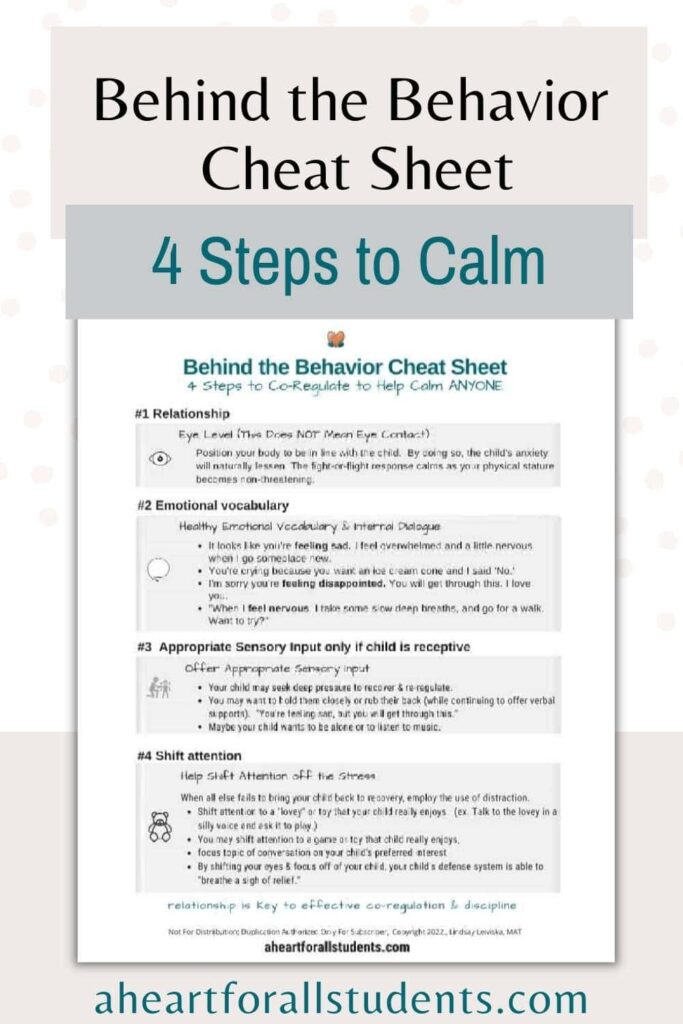
- Behavioral Cheat Sheets
- Download the FREE 4-step framework I use to diffuse meltdowns and support my kids.
Print them out and stick them on the fridge.
Share With Caregivers
Then print some extra copies to educate and empower other caregivers.
- Spouse,
- Child’s teacher,
- Babysitter,
- Grandma,
- Sunday school teachers,
- Childcare providers,
Hopefully, they’ll listen and will thank you for your help. Remember, this is a team effort. You’re not meant to do this alone.
11. Learn About Autism from Autistic People
According to the Autistic Self-Advocacy Network, Autism is a developmental disability that affects how Autistic individuals process and experience the world around them.
Every autistic person experiences autism differently, but there are some things that many of us have in common.
Let’s take a look at some common Autistic traits from a perspective you likely don’t hear very often. The Autistic Self-Advocacy Network describes autistic individuals as unique in a variety of ways. Specifically, the autism spectrum includes differences in:
- Thinking
- Processing sensory experiences
- Movement
- Communication
- Socialization
- Daily living needs
Much like everyone else in this world, autistic people are not all the same. It’s called a spectrum for a reason.
1. Thinking
Autistics often appreciate things that others don’t. Like those with ADHD, many autistic people struggle with executive functioning. Some may have an intellectual disability.
Additionally, many autistics need more time to process language and other information.
2. Sensory Processing Experiences
Autistic children and adults often navigate a unique sensory experience. Some are more sensitive (hyper) to bright lights, loud noises, and textures. While others are undersensitive (hypo) and seek out more intense forms of sensory input.
3. Movement
Many autistic individuals have a hard time with fine motor and larger gross motor skills. When not given the proper support, this can lead to incredible frustration.
Additionally, autistic individuals are known to “stim” to engage in healthy self-regulation. Stimming refers to repetitive movements that provide the brain and body with calming input.
4. Communication
Many autistic kids and adults use different forms of communication. Oral speech requires intense muscle coordination which can make it challenging to speak aloud.
Some autistic people don’t talk and rather use Augmentative and Alternative Communication such as:
- typing,
- writing,
- making gestures,
- facial expressions,
- or using a speech-generating device.
As mentioned earlier, most autistic people are Gestalt Language Processors. This means they learn to speak using echolalia (repeating words or phrases repetitively).
5. Socialization
Autistic adults and children have a different set of social skills compared to neurotypicals. Eye contact can be overstimulating.
Additionally, many autistics may not be able to control their facial expressions. This can lead to mutual social misunderstandings between non-autistics and autistics. Understanding this is the first step to supporting autistic children.
6. Differing Needs at Different Times
Like all people, every autistic person has different needs and capabilities. Some need more help than others depending upon different scenarios.
A Word About Functioning Labels
That last trait is specifically directed at the use of functioning labels. Autistic advocates believe the terms “high-functioning autism” and “low-functioning” are harmful to those with developmental disabilities such as autism.
According to Kat Williams, an autistic woman diagnosed at the age of 32,
‘High functioning’ is not how an autistic person experiences being autistic, it’s how society experiences the autistic person.”
Critics of functioning labels believe that these terms are stigmatizing, isolating, and have disastrous impacts on the lifetime experience of autistic people. (For more on functioning labels.)
Fortunately, for the new generation of autistic children, autistic adults and other autism advocates are working to change the narrative.
Recap: Anger Management for Autistic Children
Regardless of where you and your child are on this journey, I want to encourage you. If you’re concerned by your autistic child’s need for emotional regulation support, don’t be. Rest assured that this is one of the best gifts you can give your child.
God chose YOU to parent your kiddo for a reason. You can do this… even when you make mistakes. Expect mistakes as part of this journey, Friend. Then give yourself lots of grace. This is how we learn.
So, what do you think? Do any of these suggestions resonate?

About the Author:
Lindsay is a trauma-informed educator with a Master’s Degree in Teaching. Her mission is to support moms to equip neurodivergent kids (ADHD, Autism, Dyslexia, Anxiety) to thrive as exactly who they’ve been created to be. Wait until you hear the story that led to it all…

My 16 year old son prefers to NOT be identified in any certain way (related to ASD), but if he must be, he prefers to be identified as a person on the autism spectrum or a person with autism spectrum disorder. He does not like to be called autistic. I think this is because calling him autistic labels him
As all or only that versus saying he’s a person with autism spectrum disorder, or a person on the autism spectrum disorder clearly identifies him first and foremost as just “a person”. He just wants to be like everyone else and does not want to be called out or labeled as anything in particular.
Tracy, Thank you for honoring your son’s chosen way to be identified. In the end, that’s the best way to go. Honor how people want to be addressed and identified. He sounds like an amazing young man who has been blessed with a wonderful momma. 🙂
With respect and kindness, you’re using ABA without realizing it. ABA is a science, not a specific practice.
Bill, Tell me more. Would love to hear your thoughts. My goal is to lift up autistic voices on the practice of ABA which has traumatized generations of people. I understand behaviorism as a “science” and understand the nuances of influencing behaviors. However, without truly attuning to children and creating an emotionally safe experience, we fail them and hurt them. Yes, we all influence one another’s behavior to some degree. However, relationship must come first and be reciprocal. Children deserve to experience safety and love above all else.