
Playing games is a great way to strengthen the ADHD brain. Today, let’s explore some of the best games for the ADHD brain. Then we’ll discuss ADHD and its relationship to:
- executive functions
- mental health
- social skills
- emotional regulation
- and more
Let’s get started.

ADHD, Executive Functioning, & Kids
Now, when you think of ADHD and young children, you likely don’t think, “Wise and responsible.” And that’s for good reason.
Kids with ADHD (attention deficit hyperactivity disorder) struggle with delayed executive functioning. Executive functioning refers to a set of skills that develop over a lifetime. These skills specifically help us make wise and responsible decisions.
- Following Directions
- Sustained Attention
- Working Memory
- Planning & Foresight
- Perseverance
- Organization
- Impulse Control
- Emotional Regulation
- Flexible Thinking
Again, inherent to an ADHD diagnosis are challenges with executive functioning. So, it only makes sense that kids with ADHD need extra support to develop these skills. This is where playing the right games can greatly benefit the ADHD brain.
My Kid Loses It When He Loses Games
It is well known that kids with ADHD struggle with low frustration tolerance, especially when losing. When an ADHD child loses, they have an intense negative emotional reaction for a variety of reasons.
- lack of emotional regulation skills
- history of failure
- low self-worth
Because of this, for a child with ADHD, losing can feel overwhelmingly defeating. Their intense emotions often lead to behavioral problems that can hurt them even more. This lack of emotional regulation can hurt their social interactions.
Unfortunately, teachers and parents of children with ADHD often believe that poor reactions to losing are willful when they’re not. They mistakenly push the child to continue playing a losing game or remove them from the game until they can “learn to behave.”
This is a recipe for disaster that can lead to further negative effects on that child’s emotional regulation skills.
Rejection-Sensitive Dysphoria & Competition
According to Dr. William Dodson, children and adults with ADHD often suffer from Rejection-Sensitive Dysphoria. This increased sensitivity leads kids and adults to experience intense psychological distress in response to failure.
So when you’re using games to help a child with ADHD, you must create a fun and safe environment for them to grow. This means modifying the rules to allow the child a fighting chance at success. The good news is that by doing so, you’re helping the child.

This post may contain affiliate links. As an Amazon Associate, I may earn a nominal fee from qualifying purchases. Thank you for your support. See my disclosure policy for more info.
Support ADHD Kids in Play
So, why use games with your ADHD kid, if it’s only going to lead to meltdowns?
The objective of playing ADHD games is to work on improving the executive function skills that an ADHD child lacks. In this case, frustration tolerance and emotional regulation would be the objectives.
Most often, this means the rules of the game need to be modified for the ADHD child to take the next step. Let’s look at an example using a fun and engaging card game you may have heard of, Spot It.
Spot It (2-8 players)

Spot It is a great tool to help kids who have a short attention span. Use this game to improve your child’s focus and strengthen visual discrimination in a low-stress way.
Here’s how the game is designed.
- The game is made up of 55 round cards each with 8 different symbols on them.
- There’s only one matching symbol between any two cards.
To keep things interesting, there are multiple ways to play the game. However, the ultimate objective is the same regardless.
- Players want to be the first to find a match between each set of two cards.
Depending on the severity of ADHD symptoms in your child, your alarm bells may be going off after reading that description. Did you notice a problem with the game’s objective? Read that again if you didn’t catch it.
The main problem with this game for young people with ADHD is in these three little words:
“BE THE FIRST.”
What’s Wrong with Following the Rules?
Those three words set many young ADHD brains up for failure. So, let’s talk about why.
“Be the first” increases the intensity of competition between players.
A child with ADHD receives approximately 20,000 more negative messages by the age of 10 than their neurotypical peers.
We cannot underestimate the power these messages have over a child’s sense of self-worth. It’s as if their nervous systems are primed for failure based on the harsh realities of their everyday life.
ADHD Games are Tools to Be Modified
As an educator, I’m constantly modifying the curriculum to meet the needs of my children. Further, I recommend that parents and educators do the same for their students.
Like curriculum, when used for the benefit of supporting a child with ADHD, games should be used as tools.
One version of Spot-It is called “The Tower.” In this version,
- Each player is given a card that’s displayed face up.
- A shared draw pile is placed in the center with the players’ cards surrounding it.
- One card is flipped face-up on the draw pile.
- Players are supposed to find the matching symbol and call it out.
- Whoever does that first, collects the card, revealing a new card in the draw pile.
Rather than making the game a competitive experience, take turns.
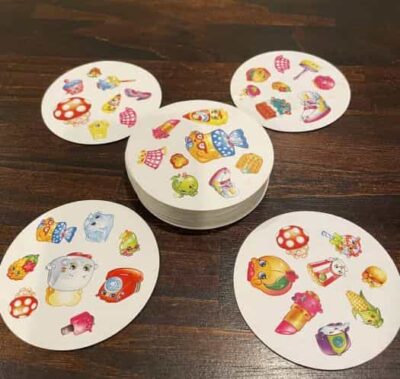
Modifying “The Tower” Version of Spot-It
Set up the cards in the same way, but allow everyone a chance to find a match, one at a time.
Making this simple adjustment will allow everyone to feel successful playing Spot-It. The pressure of the time crunch is eliminated and the child takes their first step in developing the following skills.
- Turn Taking
- Taking-turns is not easy for those with ADHD. It’s a great way to help the ADHD brain delay instant gratification, a needed executive functioning skill.
- Visual Discrimination
- (ADHD children and adults often struggle with visual discrimination.
- This is a sensory processing issue where the brain has to tease through visual input and focus on what’s most important.)
- Concentration skills and sustained attention
- Removing the pressure of time and competition allows players “felt safety” to focus to achieve the goal.
Whenever modifying a game to support someone with ADHD, ask yourself,
“What’s my goal?”
That will help you modify the game to meet that person’s needs.
Learn more about the value of a clutter-free design for ADHD brains.
Related Post:
Board Games for ADHD
Since I’ve got an ADHD family, we’ve had lots of time to collect and play educational board games. Here are a few of our favorite ADHD games that help with executive functioning.
1. Q-Bitz

Q-bitz is a fantastic visual acuity game that requires intense focus and attention.
Each block is covered on all six sides with picture patterns. The goal is for players to compete to see who can recreate the pattern card the fastest.
Again, for the rejection-sensitive person, modify Qbitz into an independent brain game. Or sit around the table as a family, and work one by one on the images as individuals for fun.
In our home, we use Qbitz as a self-regulation exercise. The concentration involved in solving the puzzles can be very calming.
2. Stare Junior

Stare Junior is a fantastic game for the ADHD brain. Have fun while strengthening your attention, concentration, and memory.
Players pull a picture card and are given 30 seconds to memorize the details of the image. (If a timer causes anxiety, remove the timer and make the objective attention or memory building.)
When the time is up, another player asks them specific recall questions.
The pictures in Stare Junior are fun to look at, and vary between old-fashioned comics, illustrations, etc.
3. No Stress Chess
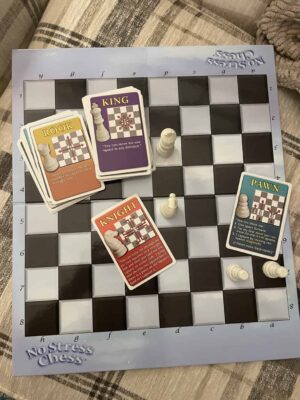
The benefits of chess are numerous for anyone, but especially those with ADHD. Playing chess helps strengthen focus, concentration, working memory, strategy, problem-solving, and more.
However, learning to play chess can be intimidating. So, for the ADHD child or adult who wants to learn how to play chess, there’s no better game than No Stress Chess.
Overall, board games are a great way to strengthen executive functioning skills in a fun and emotionally safe way. No Stress Chess is a great option.
Physical Activity Games
The benefits of physical activity for the benefit of the ADHD brain cannot be overstated. Active games for ADHD kids and families include the following.
1. “Simon Says” for Selective Attention
Selective attention is the ability to zero in on what’s most important (ignoring what’s not) to respond appropriately. There are two types of selective attention.
- Visual
- Auditory
Simon Says is a great way to improve selective attention in those with ADHD. By calling out directions, kids (and adults) have to tune out sensory input around them to the instructions.
The fun game element increases dopamine which is essential for attention. Additionally, the large gross motor movements combined with auditory instructions, further develop these skills in a multisensory way.
On the other hand, when the individual with ADHD takes on the role of “Simon,” they’re motivated to work on their communication skills.
2. Red Light, Green Light
Head outside and play this classic backyard game. Red Light, Green Light game is fantastic for strengthening executive functioning in ADHD. Specifically, auditory selective attention, self-control, and flexible thinking.
The exercise alone is perfect for releasing pent-up energy and increasing dopamine and other feel-good neurotransmitters that the ADHD brain often lacks.
Further, in 2019, a University of Chicago review indicated that being in nature can increase cognitive flexibility, working memory, and attentional control tasks.
While Red Light, Green Light can be helpful for some children with ADHD, remember that some will have a hard time with the competitive nature of the game.
Additionally, those with physical limitations may be at greater risk of getting hurt or coming in last. The last thing you want to do to help a child with ADHD is to increase the chances of failure.
It’s always a good idea to keep each child’s needs in mind when choosing ADHD games. The best way to modify games for a child with low self-esteem is to practice with emotionally safe family members.
3. Dance Party
Dancing to upbeat music is a simple activity to help the emotionally dysregulated ADHD child (or adult) find calm. Or, use music and dancing to release pent-up anxiety-related energy. Another benefit of dancing to upbeat music is that it’s a great bonding experience for families.
Occupational Therapists & ADHD Support
Occupational therapists are wonderful resources for neurodivergent children such as those with ADHD and Autism. A good occupational therapist will have a solid understanding of the brain and behavior.
I recently asked a trauma-informed occupational therapist for some new games related to improving attention, focus, and emotional regulation. She recommended using the interactive metronome to guide specific movements.
Interactive Metronome & ADHD
The idea behind the use of a metronome is that it supports the reregulation of the brain’s internal clock by the use of rhythm in time. Within the temporal lobe (the area of brain responsible for keeping time), is our internal clock.
The proper function of the internal clock supports language development, motor coordination, and healthy responses to sensory input. Those with ADHD are notorious for time blindness. That means those of us with ADHD struggle with time management in a way that negatively impacts life.
This can look like:
- Failing to get schoolwork completed on time
- Being late or too early for obligations
- Taking forever to complete tasks
Studies have shown that the interactive metronome can help improve attention span as well as bilateral-coordination.
Bilateral Coordination for the ADHD Brain
Bilateral coordination is essential for proper attention function and overall brain function. Specifically, brain integration therapy and bilateral coordination impact the brain powerfully.
- reading,
- writing,
- spelling,
- math,
- emotional regulation,
- sensory processing,
- and more.
Further, this applies to adults with ADHD and other cognitive challenges. (Older adults or those who are struggling with working memory, organization, and emotional regulation.)
Interactive Metronome Activities
One fun and easy way to support the ADHD brain with an interactive metronome is to download a free metronome app on your phone.
- Snow Angels: Lie on the floor and practice making snow angels to the sound of the metronome.
- Clapping Games: Practice clapping your hands or your lap in unison with your child and the sound of the metronome.
- March in Place: March in place to the beat of the metronome while slapping the knee with the opposite hand. This is a great way to strengthen bilateral coordination of the brain.
- Ball Bounce: Have your child bounce a ball on the ground in timing with the metronome.
If you’re familiar with Dianne Craft’s work with dyslexic children, you’ll remember that she uses brain integration therapy such as these above-listed activities. Brain, learning, and behavior. They’re all connected.
Have your child engage in brain games to increase attention for school work.
Related Post:
Martial Arts for ADHD & Brain Integration
I cannot more highly recommend martial arts for the ADHD brain. In my own life, I often describe martial arts, specifically Taekwondo, as “occupational therapy” for my kids.
Including martial arts as part of any ADHD child’s daily routine. In our home, we love Taekwondo as it increases:
- attention,
- self-discipline,
- listening skills (selective auditory attention),
- bilateral coordination of the brain and body,
- gross motor coordination,
- leadership skills,
- character development,
- physical exercise,
- and more
For more information about finding a qualified Taekwondo studio in your area, USA Taekwondo is an excellent resource.

Gaming & American Children
If you’re like me and other parents, you may be concerned about your child and the issue of too much screen time.
Experts are vague in their screen time recommendations for kids over the age of 6 as the research is still ongoing.
However, the American Academy of Pediatrics and the World Health Organization both discourage screen time for children under the age of 2.
Not surprisingly, their data also tells us that American children are getting a lot of screen time.
- Elementary school kids between ages 6-12: 4-6 hours per day
- Teens: Up to 9 hours per day
That’s a long time!
ADHD & Addictive Behaviors
Because children with ADHD are at higher risk for internet addiction, we must be informed. So, how do online games and the virtual world impact those with ADHD?
Well, the good news is that video gaming and internet use do not cause ADHD. However, there is a link between ADHD and susceptibility to addiction.
According to a 2018 study, up to 23% of gamers admit to addictive behaviors related to video game use. Additionally, it appears that ADHD severe ADHD symptoms are associated with an increased risk of video gaming addiction.
However, our kids must live in an online world to some extent. And video gameplay is here to stay with approximately 3 billion gamers worldwide. With this in mind, how can we use video games to benefit ADHD kids and adults?
Video Games for ADHD
More recently, video games have been designed to help those with ADHD strengthen various executive function skills.
For example, two ADHD video games are discussed below.
- EndeavorRX
- Joon
Let’s see how these video games may be able to support ADHD thinkers.
Digital Therapeutic Video Game?
In 2020, the Food and Drug Administration approved a video game-style app for ADHD called EndeavorRX.
The video game is designed to strengthen the inattentive traits of ADHD with the algorithm modifying the challenges based on the child’s responses.
It requires a prescription by a doctor and is approved to strengthen the attention of kids ages 8-12 years old. Using a tool like EndeavorRX is a good example of using screen time positively.
The early research shows promise as part of a therapeutic program for ADHD. However, further study will be needed to get most insurance companies to cover the cost.
A bonus of EndeavorRX is that kids don’t have to spend much time using it to achieve results. (No more than 25 minutes a day five days a week.)

Digital Game for ADHD Task Initiation & Competition
Want your child to complete school work and household chores without being asked? You’re in luck!
Joon is another ADHD video game for kids that helps with task initiation and completion. This digital app does not require a prescription and is recommended by child psychologists, occupational therapists, and educators.
Joon requires the use of a mobile device. Parents can add daily chores and responsibilities (Quests) into the app and assign “rewards” for completing these “Quests”.
Immediate rewards after completing tasks provide the ADHD brain dopamine which boosts motivation to develop these habits.
Plus, the gamification of this ADHD app is engaging as it takes place in an imaginary world of mystic creatures.
When chores are completed, children earn coins that they can use in the gaming environment. (Think Robux for Roblox or V-bucks for Fortnite).
Quick Tutorial: Dopamine, Attention, & Hyperfocus
Learn about dopamine, attention, and hyperfocus in this quick Youtube Short on A Heart for All Students channel.
Minecraft for ADHD
According to a clinical child psychologist, Randy Kulman, Ph.D., Minecraft is a good choice of video game for ADHD kids.
In 2021, he shared the positive effects of playing Minecraft. Playing Minecraft helps children develop important skills such as executive functioning skills.
- Planning,
- Flexibility,
- Organization,
- Collaboration,
- and Creativity
Of course, Dr. Kulman recommends against the excessive use of video games. However, when used in moderation, Minecraft is a good option.
Recap: ADHD Games
As an ADHD adult diagnosed at the age of 41, I know the challenges that come with an ADHD brain. However, I also know that it also comes with incredible strengths.
That being said, when supporting any loved one with ADHD, remember the strengths. Look for the strengths and support them.
This is especially true for children. Historically, those with ADHD, Autism, and neurotypes have not been supported well.
Kids with ADHD do not need to be changed. They need to be loved and encouraged to thrive as the people they are.
Use board games, card games, active games, and other activities to harness the power of the ADHD brain for good!
So, what say you, Friend? Would love to hear your thoughts.

This post may contain affiliate links. As an Amazon Associate, I may earn a nominal fee from qualifying purchases. Thank you for your support. See my disclosure policy for more info.