
ADHD paralysis occurs when the brain becomes overwhelmed with the amount of input coming at it and, in response, shuts down. In other words, the ADHD person freezes at the volume of responsibilities, tasks, and decisions and ends up doing nothing. If you can relate, I get it and am in it with you. Here are 5 ways to end ADHD paralysis.

This post may contain affiliate links. As an Amazon Associate, I may earn a nominal fee from qualifying purchases. Thank you for your support. See my disclosure policy for more info.
My ADHD Paralysis
Because I wasn’t diagnosed with ADHD until adulthood, it took years for me to understand the meaning of ADHD paralysis. For years, I had a hard time taking action on my to-do list and suffered from analysis paralysis.
Now I know that my challenges in making decisions and taking action are some of my most obvious ADHD symptoms. Fortunately, I’ve managed to come up with five ways to survive my ADHD paralysis tendencies.
I hope these strategies help with your ADHD paralysis and adult ADHD journey.
5 Ways to Overcome ADHD Paralysis
Here are five ways to overcome ADHD paralysis and improve your ADHD quality of life.
1. Learn About Your ADHD Brain
The first thing I recommend for anyone with ADHD is to embrace and get to know the brain you have. As Dr. Daniel Amen says,
Love your brain.
Your ADHD brain is a genius when you know how to work with it. Learn all you can about the ADHD brain and how it works. Then take note of your specific set of symptoms and use them as clues to create strategic coping strategies.
Time Blindness in the ADHD Brain

Oh, the whole time management thing. Those of us with ADHD are notorious for time blindness. Researchers believe that in ADHD,
The differences in the perception of time point to possible differences in communication between different parts of the brain, including the hippocampus.
Radek Ptáček, PhD, Czech clinical psychologist
I’ve wasted so much time on non-essential tasks because I’ve struggled with my perception of time. In the past, I would’ve beaten myself up for my poor time management skills. However, I now understand that this is part of how my ADHD brain works.
This means I need outside support tools to support my time management skills. Like you, I’ve used a variety of time management tools. Like most things in life, the best daily planners for ADHD brains are the ones you will use.
2. Five Time Management Tools for ADHD
Here are five of my ADHD time management tools to help me overcome ADHD paralysis. Hope they help you.
1. Daily Planner
The daily planner doesn’t have to be anything fancy. It’s got to be something that you’ll use. Here’s my ADHD Planning System that’s finally working.
2. Monthly Calendar
I use Google Calendar because I can access it on my phone and my laptop. Further, it easily connects with my Google Drive.
3. Daily To-Do List
I use the Do app on my iPhone. Additionally, I use a basic three-ring spiral notebook to write out my daily to-dos. Writing with a pen and paper helps me remember more effectively.
4. Timer
Using a timer is a great way to help you stay on track of time. I use a timer for two reasons.
- Task Initiation
- Protection from Distraction
How I Use a Timer for Task Initiation
As I mentioned earlier, I use a timer to help me with task initiation. When I can’t motivate myself to begin a mundane task, I set a timer on my phone for 20 minutes just to get me started.
My promise to myself is that once the timer goes off, I can be done. However, I usually keep going and thus, make progress.
How I Use a Timer as Protection from Social Media
I also use timers to protect myself from the vortex of my ADHD hyperfocus. Before I get on social media, I set a timer for 15-20 minutes to make sure I don’t become hyperfocused and lose the entire day.
5. Alarms
Alarms are the ADHD brain’s best friend and they’re not just for waking up in the morning. Here’s how I use alarms. Every evening I set various alarms for the following day.

- Open Google Calendar and look at the schedule for the following day.
- Then, I add alarms to remind me:
- when to work out
- when to leave for appointments
- classes for the day
- reminders to complete urgent tasks
- (I simply change the alarm Label in my iPhone).
By setting yourself up with external time management support tools, you’re better able to complete day-to-day activities.
3. Make Jobs Manageable
Another way to support your ADHD brain is to eliminate some of the overwhelm. Break larger tasks into manageable smaller tasks.
Unfortunately, one of the most common symptoms of ADHD is trouble with flexible thinking. This means that those of us with ADHD often fall into the trap of black-and-white thinking.
You know what I mean. It’s that either all in or either all out. We struggle with the grey area.
This makes it easy for us to look at a job or task as too big to handle now, so we just don’t handle it at all. (We’re always looking for the perfect time and place to do whatever it is we need to do.)
For example, don’t push off that big project until you’ve got an uninterrupted 5-hour block of time. That block of time will never arrive.
Instead, break it up into smaller pieces and it’ll take you much farther. So, how do you do that?
ADHD Planning vs Non-ADHD Planning
In a non-ADHD world, you’d sit at your desk for 20 minutes. Then, you’d write out the steps involved in the project. Let’s take writing an article for your (ahem… my blog) as an example.
Maybe you’d come up with a rough plan like this.
- Research
- Create an outline
- Write the main paragraphs
- Create an intro and conclusion
- Create images in Canva
- Format in WordPress
- Add backlinks
Then the next time you’ve got 15-20 minutes, you’d start the research, then the outline, and so on. Or, on the other hand, perhaps you recognize that you still have ADHD and don’t have time for that. (I’m being real. It’s ok to own your impulsivity.)
Grab your timer, set it for 20 minutes, and start working for that period. Over the days and the weeks, you’ll get so much work done. Small tasks completed over time, will yield fruit and keep your to-do list from backing up.
4. Develop Stress Management Techniques
As discussed earlier, one of the risk factors for mental paralysis is stress and the risk is greater in the ADHD brain.
One way to support your executive functioning and improve your overall well-being is to engage in activities that support your mental health.
Specifically, make it a priority to add stress management practices into your lifestyle.
Here are two stress management techniques.
- Regular Exercise
- Prayer, meditation, or journaling
- Deep diaphragmatic breathing
Regular Exercise

For me, this is HUGE. I’m confident that my daily exercise habit has kept me functioning throughout the years. Now, I started this exercise routine more than 20 years ago so this is relatively easy for me.
SPECT scans have shown that ADHD is associated with decreased blood flow to the brain. It’s because of this that exercise is a precious tool for those with ADHD.
Weight-bearing and cardiovascular exercise improves blood flow throughout the body and brain. Even if you aren’t in the habit of exercising yet, start small.
- Add a 5-minute walk to your routine in the morning, at lunch, and after dinner.
(Pay close attention to your tendency to think all or nothing.) Start small and see where the exercise high takes you.
Quick Dopamine Tip
To make exercising easier, pair it with dopamine. To make exercise more enjoyable, listen to:
- an engaging podcast or
- upbeat music
Do what you have to do to get your body moving. Here are more ways to increase dopamine.
Prayer, Meditation, or Journaling
Spend some time processing your thoughts and feelings through prayer, meditation, or journaling. One of the major symptoms of ADHD is trouble with non-verbal working memory.
This is why it’s often challenging for those with ADHD to sit quietly to meditate or to pray in silence. If this is you, try journaling. Adding a pen and paper to your habit can improve engagement. (This is why children do well with fidgets or other mindless activities to learn.)
Pin Me to Your Favorite Pinterest Board!

5. Get Mental Health Support

One of the most helpful stress management and ADHD life support strategies I’ve used is this. Working with a therapist.
While some recommend cognitive behavioral therapy, for those of us with ADHD it’s not always effective. Many ADHDers have years of negative self-talk and shame experiences built up.
Our current understanding of neuroscience helps us better understand how repeated negative shame experiences throughout childhood lead to a dysregulated nervous system. (Think. The lower brain is in fight-or-flight-freeze as a perpetual cycle.)
EMDR and Trauma Informed Therapy for ADHD
This means that talk therapy, which relies on reasoning and language in the cortex of the brain, is often not as effective in resolving deep-rooted issues.
EMDR therapy is a scientifically sound modality of psychotherapy that’s effective in processing and resolving trauma. I recommend it for healing and resolving issues that may be impacting your ability to function optimally.
ADHD Paralysis Freeze
While ADHD paralysis is not considered part of the formal diagnostic criteria, it’s a common experience of adult ADHD.
For those of us with ADHD, keeping up with daily tasks seems daunting. However, when we experience periods of stress, those responsibilities can feel insurmountable. To be honest, it can be any particular task that throws us into a loop.
Just the perception of something being “hard” can be enough for the amygdala to perceive it as a threat and therefore, shut down all functioning. This freeze response is controlled by a much stronger lower brain.
Quick Tutorial: ADHD Paralysis
Watch this quick ADHD Paralysis tutorial on A Heart for All Students channel.
Let me set the stage for you…
What Does ADHD Paralysis Look Like?
ADHD paralysis can look different depending on the person and the situation. It can look like this:
- Zoning out
- Spinning in circles in the middle of a messy kitchen or home because you don’t know where to start.
- Jumping from thing to thing never completing any one specific task
- Putting off a hard decision until “later”
Further, it’s often broken into three types.
- Choice Paralysis
- Struggling to make important decisions
- Task Paralysis
- Challenges beginning simple tasks
- Mental Paralysis
- When the brain receives too much information at one time. Competing thoughts, ideas, emotions, and demands, cause a virtual shutdown and you can no longer communicate.
Though young children may not use the phrase ADHD paralysis, they often experience it as a daily ADHD symptom.
The Brain’s Role in Paralysis
When discussing ADHD paralysis, it’s important to have a basic understanding of brain structure.
Think of the brain in three parts working from the bottom up.
- Lowest Part (Brainstem & Cerebellum):
- Responsible for automatic processes in the body such as breathing, heart rate, and blood pressure.
- Middle (Limbic System and amygdala):
- Responsible for creating memories and emotions. This region of the brain is responsible for fight-or-flight and happens automatically (without thinking).
- Upper (Cortex of the Brain):
- Responsible for conscious thought and decision-making. The prefrontal cortex is the last part of the brain to develop in human beings. It does not fully develop until the 3rd decade of life.
Yes. You read that right. In a neurotypical brain, the prefrontal cortex doesn’t develop until approximately the age of 25 years old. In ADHD, the prefrontal cortex develops even later.
On the other hand, guess which parts of the brain are fully developed at birth? Yep. You guessed it. The two most responsible for big emotional reactions.
ADHD Brain & Executive Functioning
According to the DSM-V (Statistical Manual of Mental Disorders), ADHD is the most common neurodevelopmental disorder.
In the United States, over 6 million children have ADHD, with another 2.5-4.4% of adults also with an ADHD diagnosis. It’s diagnosed as one of three subtypes of Attention Deficit Hyperactivity Disorder.
- Hyperactive-Impulsive type (associated with hyperactive-impulsive symptoms)
- Inattentive type (used to be diagnosed as attention deficit disorder or ADD)
- Combined type (presenting with both symptoms of hyperactivity and symptoms of inattention)
Core to ADHD are challenges with the brain’s executive functions. Executive functioning challenges impact a person’s ability for critical thinking, self-control, and making good decisions.
It’s important to note that executive functioning skills are housed in the prefrontal cortex area of the brain.
7 Executive Functions
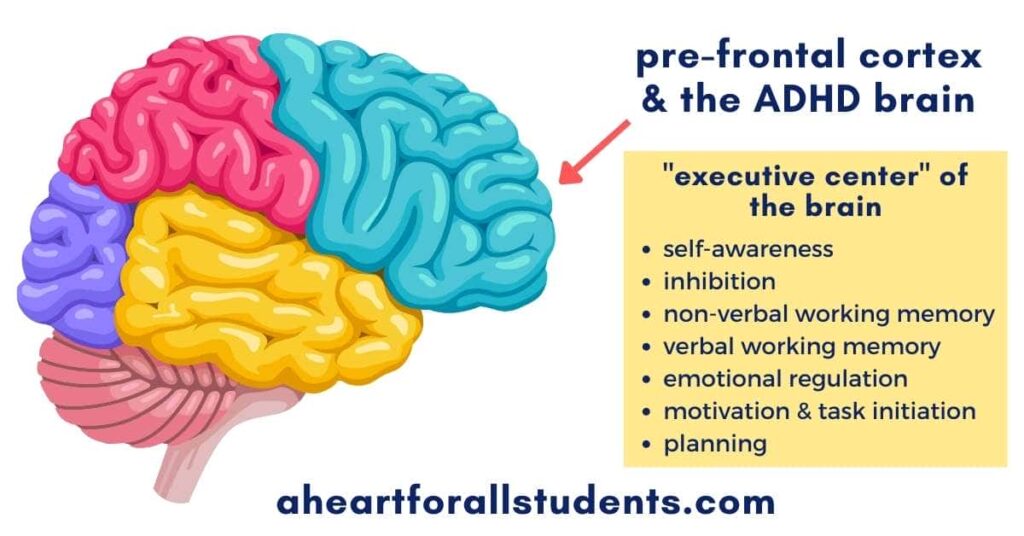
Ok. Now, place your hand on your forehead. Your prefrontal cortex is the home of your executive functioning skills. And they’re right behind your forehead.
In those with ADHD, the prefrontal cortex is slower to develop. This explains why executive functioning is delayed and impaired in ADHD. According to Dr. Russell Barkely, there are 7 executive functions.
- Self-Awareness
- Inhibition
- Non-Verbal Working Memory
- Verbal Working Memory
- Emotional Self-Regulation
- Self-Motivation
- Planning & Problem Solving
Children and adults with ADHD may struggle with some or all of these executive function skills which impact learning, behavior, relationships, and social skills. These executive function challenges are often referred to as executive dysfunction.


ADHD Brain Structure & the Prefrontal Cortex
Remember those seven executive functioning skills we discussed earlier? To review, those skills help us override our big emotions to make wise and appropriate choices.
Again, those lagging skills are located in the prefrontal cortex we just spoke of. So, let’s put this all together, The executive functions that help humans make wise choices and demonstrate self-control are housed in the most underdeveloped area of the ADHD brain.
Bouncer at a Club
Since the brain works from the bottom up, think of the ADHD prefrontal cortex as the bouncer of the club. His job is to make sure that the emotionally charged lower brain levels don’t get out of hand and cause trouble.
The problem is that the ADHD brain’s bouncer is a pip-squeak. He often doesn’t have the strength to hold the emotionally charged lower brain back.
For example, imagine that feeling of rage that rises when your mother-in-law judges your parenting style. It’s your executive function skills that allow you the self-control not to whack her with your strong left hook.
ADHD Limbic System & Freeze
Going back to the middle brain or the limbic system.
This part of your brain is part of your autonomic nervous system. This means that the limbic system responds to external input automatically.
Its job, by design, is to scan the environment to look for perceived threats.
It doesn’t have time to consciously think about them. That amygdala must keep you safe and it does so using fight-flight or freeze.
Fight-flight-or-freeze. Think about those three words.
Pop quiz. Which one of those three words is a virtual synonym for the word “paralysis”?
You got it. FREEZE.
And why does the amygdala react with fight-flight-or-freeze? That’s right. To protect itself from threats.
So, why does the ADHD brain freeze up? What does that look like?

Choice Paralysis
When someone experiences choice paralysis, they’re worried that they’re going to make the wrong choice.
This is not surprising when you think about it. Of adults with ADHD, 53% have a co-occurring anxiety disorder.
Combine that with the psychological distress associated with growing up hearing about your mistakes regularly and you’ve got the perfect recipe for anxiety.
Low self-esteem is a common side effect of ADHD. According to Dr. William Dodson, children with ADHD receive 20,000 more negative messages by the age of 10 than children without ADHD.
This is sure to impact one’s self-confidence and resulting ability to make the right choices. After all, adults with ADHD have a history of being children with ADHD (diagnosed or not).
Making decisions is hard for those without ADHD. Further, making decisions becomes more challenging as the number of options increases.
If you find yourself overwhelmed when faced with many choices, you’re not alone.
Cheesecake Factory Menu
Been to the Cheesecake Factory lately? The sheer number of menu items makes the decision daunting.
To be honest, the last time I was there with a group of friends, it took nearly 35 minutes for all of us to make our menu choices.
Think about it. When looking at a menu of that size, your brain has to process a lot of input. Specifically, it has to filter through…
- visual input and text on each page of the menu,
- the loud music playing overhead,
- the glare of bright lighting,
- as well as attend to the social cues of friends
The point is that the brain only has so much capacity to process, and then make a decision. The next time you find yourself experiencing ADHD decision paralysis, take a deep breath. You’re in good company.

Task Paralysis
The next type of ADHD paralysis is task paralysis and it relates to challenges with task initiation. When you’ve got a to-do list a mile long, it’s overwhelming to even start on one. This leads to a cycle of task paralysis where you stall out before you begin.
It’s a deer-in-headlights type of situation. You know you need to get your work done, but you can’t get yourself to begin. One way to navigate task paralysis is to break larger tasks into smaller chunks.
Breaking tasks into their parts and working on one small task at a time is often a good idea. This helps me stay on task more easily and it helps me with task initiation.
Personal Task Paralysis
I remember a couple of years ago, during the collective trauma of 2020, I was a mess.
- My mom died the year before,
- a close family member was suicidal,
- my children were struggling,
- my hubby and I were navigating my son’s dysregulated state
And since my mental health wasn’t stressed enough, we decided to make a local move. The day before we were to move out of our home, I called a dear friend to help me pack.
She walked into my home and I crumbled. For the life of me, I could NOT function. Staring at the kitchen of my old home:
- all of the dishes,
- pots,
- pans,
- food items,
- cleaning products
I was frozen solid and stared at the mess as she threw open the cabinets and packed up all the boxes. My brain could no longer function. I was so overwhelmed with everything that needed to be done and everything that I’d been processing in my mind. My brain had nothing else to give.
Mental Paralysis
Mental paralysis can occur for a variety of reasons. As mentioned earlier, the brain is constantly taking in a variety of sensory information from the world around it.
All that to say, it’s got to filter out what’s not important to focus on what is important. One of the downfalls of the ADHD diagnosis is in the name itself.
ADHD is NOT a deficit of attention. In fact, it’s a problem of too much attention to too many things at once. Some describe it as not having a strong enough filtration system to adequately filter out input that’s not essential.
This can lead to one of the key features of ADHD, sensory overload. When this happens, it’s as if the lower brain regions take over completely and limit higher-order thinking as a survival mechanism.
Mental paralysis is an inability to think clearly, communicate, or process information. It can appear as inattentive symptoms, laziness, or an intense case of debilitating brain fog.

ADHD Medication & Treatments
With a solid treatment plan, the challenges of ADHD can be managed well. Many effective ADHD treatment plans include:
- a combination of medication,
- diet changes,
- and behavioral interventions.
Stimulant medications are believed to be effective because they increase dopamine levels in the brain. Dopamine, which is low in the ADHD brain, is the brain’s “get stuff done” chemical.
Specifically, dopamine is the neurotransmitter that regulates executive functioning as a process. In other words, think of dopamine as the gasoline that fuels the engine (executive functioning).
Regardless of treatment choice, it’s always helpful to think about how to increase dopamine. By increasing dopamine, you support focus, attention, and decision-making.
Recap: ADHD Paralysis
In the end, ADHD paralysis, while not diagnostic criteria for an ADHD diagnosis, is a real lived experience of ADHD. It can be debilitating to your quality of life when your lifestyle is overrun by stress.
Fortunately, awareness of this ADHD phenomenon helps prevent negative outcomes. Using specific coping mechanisms, tools, and strategies can make a huge difference.
- Time management tools,
- Emotional and mental health support,
- and Exercise
So, what say you? Do you experience the brain freeze of ADHD paralysis?
Up Next:
Benefits of IFS Therapy for Neurodivergent Families
63 Adult ADHD Symptoms in Women with FREE Checklist!
An ADHD Planning System That Finally Works for Me in 2025
19 Ways to Increase Dopamine and Improve ADHD Symptoms
Hyperfixation vs Hyperfocus: Which ADHD Symptom Wins?
Best ADHD Games for Kids & Adults to Improve Executive Function
The End of Mental Illness by Dr. Daniel Amen
No products found.
The End of Mental Illness by Dr. Daniel Amen is one of my top picks. It’s time to stop pathologizing and start equipping those we love with the tools they need to thrive.
This post may contain affiliate links. As an Amazon Associate, I may earn a nominal fee from qualifying purchases. Thank you for your support. See my disclosure policy for more info.


Interesting, to read the suggestion to journal your thoughts as a help when the short-time memory is shorter… not knowing about adhd and myself (though some of my kids), but quite sure that the one with shorter short-term memory got that from me… I have found that at work I do the thinking best when writing it, and as a teenager I started to write my communication with God… If I want my thoughts to grow and move writing is a really good tool. Nice to read that here. I had not realised that it could have a connection to a “shorter” short-term memory. But I do not at all like sittning and just thinking, kind of not getting forward, though I do feel that I remember my ongoing thoughts. However, I don’t do my thinking primarily in words (if I don’t write), I think my thinking is more kind of visual…maybe that iswhy I like to use writing (even though I don’t feel it is my first “thinking-language” I am good at it;) ).
Sara, I love all of this. Thank you for processing your thoughts about your own possible ADHD and short-term working memory. I can follow your line of processing here and can relate as an adut woman with ADHD. A lot of neurodivergent women are visual thinkers so I do think you’re on to something there. Writing or taking notes can be very helpful for the ADHD brain. Even without ever going back to reading them. Often, it’s a way to simply process and release information. To remove it from one’s head and make it concrete. Helpful tips for ADHD or anyone trying to release energy, anxiety, or as a tool for learning. 🙂 I can’t tell you how many journal prayer notebooks I have from throughout the years. I’m with you 100%! 🙂
I have such a lot of difficulty finding the words as everything is huge nameless feelings. Many years ago, before it was realized that girls could also have ADHD, and I was admitted to a psych hospital, I could not talk to my psychiatrist at all. Eventually he experimented by giving me a dose of Ritalin. I had resorted to cutting myself, but that dose broke through and I could find the words. We had a number of sessions with Ritalin and the relief was enormous. Unfortunately he was not able to prescribe it for me normally as there was no diagnostic category to apply to me, a female, to legitimise doing so. Now, 50 difficult years later (with a brother and a son with ADHD) I have just been formally diagnosed at last and awaiting medical clearance to have Ritalin prescribed routinely. If only that could have happened 50 years ago it would have resolved so much painful struggle, failure, and wasted potential. It has been so hard and taken a huge toll of me that I am grieving the loss of all those years that could have been so different if only… if only… if only.
Jude, I’m so sorry for all those years of suffering as an undiagnosed woman with ADHD. This is all too common for girls and women with ADHD and I’m so sorry for your pain. I’m so happy that you’re finally finding answers and I encourage you not to give up. There is an excellent interview about hormones in women and ADHD and it will definitely encourage you to not give up in your fight for the right medication. ADHD meds are not just for kids. I hope this helps! 🙂 https://www.additudemag.com/webinar/menopause-symptoms-adhd-estrogen-women-podcast-380/