
Printable ten frame cards are the perfect teaching tool for young children because they can be used for so many math concepts. You can use ten-frames to help kids develop a strong number sense including:
- One-to-one correspondence
- Subitizing skills
- Greater than and less than comparison
- Number bonds
- Practice number sentences with both addition and subtraction
So, whether you’re homeschooling one student or you’ve got a classroom of young learners, let’s jump in. And don’t forget to download the free printables at the end of this post.

What is a Ten Frame?
A Ten Frame is a table of two rows of five squares in each row. The purpose of the ten-frame is to help children recognize numbers less than or equal to ten (10). Additionally, children develop number sense by organizing different combinations of dots or counters within the ten-frame.
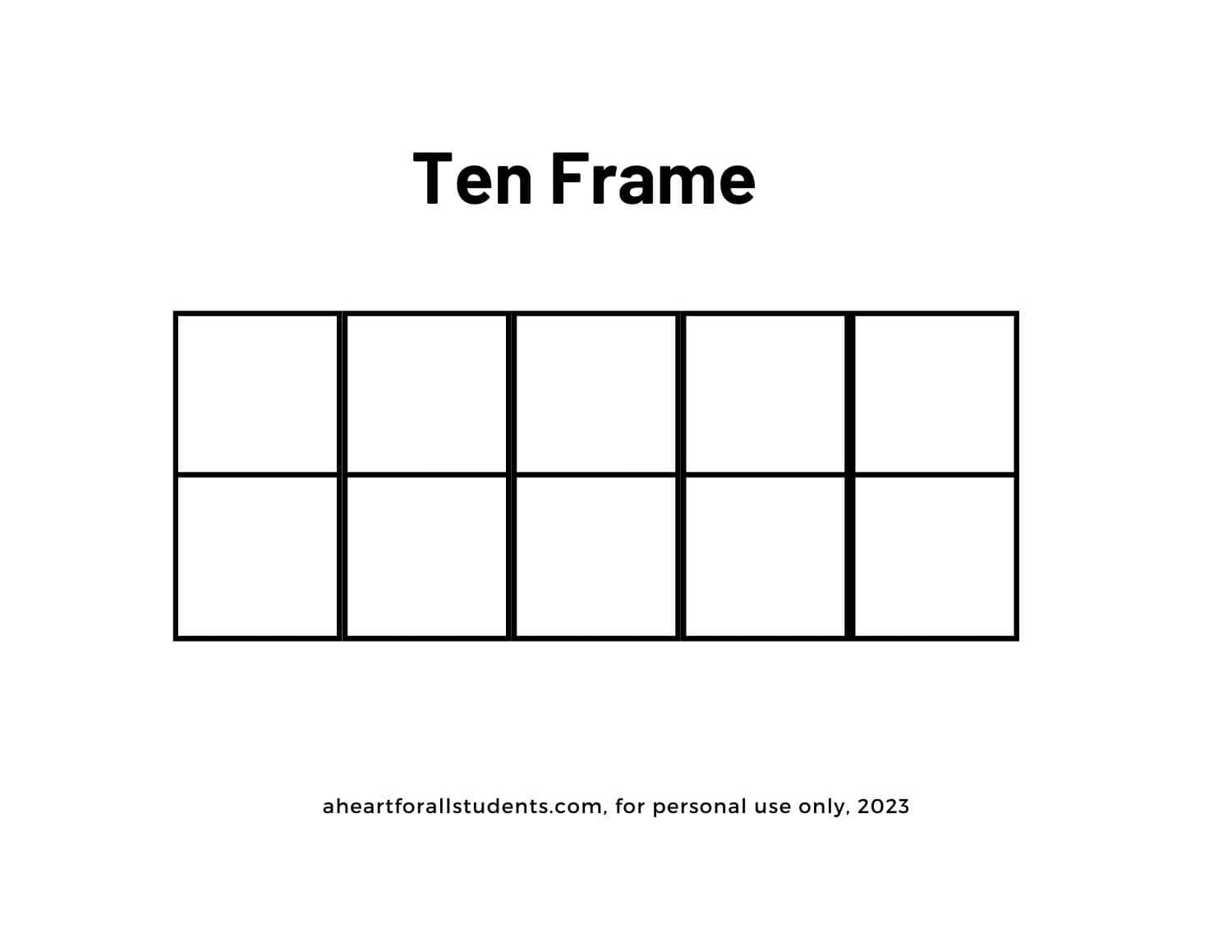
By placing a counter in each frame box, students learn that numbers can be built in a variety of ways. Specifically, they can master the number bonds that make 10.
- 1 and 9
- 2 and 8
- 3 and 7
- 4 and 6
- 5 and 5
Once kids develop fluency with number bonds that make ten, they’ll be able to transfer that knowledge to larger numbers.
Benefits of a Ten-Frame
Again, there are different ways to use ten-frame cards to improve your student’s math skills. So, let’s talk about one specifically.
As mentioned earlier, our math system is based on base-ten, or units of tens.
A ten-frame allows students to master foundational math skills with small numbers that can later be transferred to larger numbers.
- For example, a student knows that four and six make ten.
- Later, they’ll easily see that four tens (40) and six tens (60) make 100.
Another benefit of a ten-frame is that children can visually see the difference between odd and even numbers. Ten Frame templates help children make abstract math concepts real.
Using Counters with Ten Frames

When kids see numbers, they’re better able to make sense of abstract numbers. Further, using a visual math tool with math manipulatives supplies tactile input to round out multi-sensory learning.
The best part is that you can use a variety of different manipulatives with your ten-frames. Some manipulatives you can use as counters include the following.
- coins
- beans
- M&Ms or chocolate chips
- raisins
- pom poms
- stickers
- Unifix Cubes or Number Blocks
So, go ahead and dig into your craft supplies and pull out those old pom poms you haven’t used in years. Use these or any other small object to help your child develop one-to-one correspondence.
What’s One-to-One Correspondence?
One-to-one correspondence is a foundational math skill that means a student knows that one object equals the value of one (1).
Children typically learn one-to-one correspondence by touching one finger to one object as they count. Playing simple educational board games is a fun way to teach this concept.
Preparing Your Ten Frame Printables
I’ve created several printable ten frames to help. These include:
- Ten frame flash cards
- Blank Frame Cards
- Dot Cards: Ten Frame Cards filled in with counters in the form of “dots”
- Ten Frame worksheets
- and more!
When preparing your Ten Frames for use, I recommend printing them on card stock so they can be reused. You may want to print two copies of the flashcard sheets.
- Then, laminate and cut one set to use as flashcards.
- Slide the other copy into a sheet protector
- Use for building different numbers.
Additionally, I recommend inserting at least one Ten Frame picture in a sheet protector to use over the course of a week or so.
Quick Daily Ten Frame Practice
In our home, I added a Ten Frame printable to my child’s morning binder. Each morning he fills the empty frames with a specific number of dots or counters. Using dry-erase markers on the sheet protectors makes for easy cleanup for the next day.
Activities for Your Printable Ten-Frame Cards
Math concepts to practice using the ten-frames flashcards include:
- number bonds equal to ten
- comparing even and odd numbers
- practice with subitizing
- solving and building simple number sentences
Let’s quickly dive into a ten-frame activity for each skill.
1. Ten-Frame Greater or Less Than
One math concept you can teach with a ten-frame is greater than or less than. Print the two on one ten-frame printable.
- Grab a deck of Uno Cards
- Remove the wilds, plus 2s, and plus 4s
- Take turns flipping over two cards
- Place that number of counters in each of the two empty frames.
- Fill in the greater than, less than number sentence on the provided template
Have your child compare these numbers visually and determine which value is greater than the other.

2. Subitizing Memory
Subitizing refers to the ability to see a collection of items and instantly be able to identify the number of items without counting. Many of us do this without even thinking.
Just think back to the last board game you played. Perhaps you rolled the dice and moved four spaces. The truth is that you didn’t have to count the dots on the dice to know that you rolled a four (4). You did it automatically by subitizing.
How to Play Ten-Frame Subitizing Memory
A great way to develop your child’s subitizing skills is by playing Subitizing Memory.
- Print two copies of any of the ten-frame flashcards on cardstock (laminate them for extra durability),
- Lay out the pairs of cards as you would any memory game
- Take turns matching the correct values.
In the end, this is a non-threatening and fun way to help your student identify visual patterns that make numbers.
ADHD, Autism, Learning Difference Tip
Many children with Executive Functioning challenges or other learning differences struggle to take direction from authority.
Unfortunately, this is especially true of Mom because typically, Mom is that child’s safe place. If your child demonstrates demand avoidance or oppositional behavior when you’re teaching, deep breaths.
Engage in as much “backdoor teaching” as possible. Make learning non-threatening. Playing games is one way to do so.
3. Dice Math Sentences
Another simple ten-frame activity is called Dice Math Sentences.
- Roll a pair of dice.
- Place that number of counters on the ten-frame.
- Repeat using a different color manipulative for the second number.
- Write the numbers in the blank number sentence template
- Count (or add) to find the right answer.

4. Number-Bond Dice Build
Success in math depends on mastering the base-ten system. It’s the system all math depends on.
As mentioned previously, when kids know the number bonds that make ten, they’ll be able to transfer that knowledge to greater numbers. Help your child develop this skill by playing Number Bond Dice Build.
- Roll one die
- Fill in a blank ten-frame card with counters to match the rolled value
- Write that first number on the number sentence template
- In another color counter (or dry-erase marker), fill in the rest of the blank boxes to make ten.
- Write the second value in the second addend space on the number sentence sheet
Make sure to have your child verbalize the number bond that they made. Verbalizing helps solidify understanding.
Recap: Printable Ten Frame Cards
As discussed earlier, help your little learner develop number sense using multi-sensory tools. Because of this, using ten-frames with counters is a perfect multi-sensory math experience. By adding them to your lesson plans, your student will get both the visual and tactile support to better master this concept.
Whether you’re working with one student or a whole class of kindergarteners, download the FREE printable ten-frame cards and worksheets.
- Bonus: Includes guides for four learning activities!
So, friend, what do you think? Do you have a fun ten-frame activity to add?
Download the FREE Printable Ten Frame Cards


About the Author:
Lindsay is a trauma-informed educator with a Master’s Degree in Teaching. Her mission is to support moms to equip neurodivergent kids (ADHD, Autism, Dyslexia, Anxiety) to thrive as exactly who they’ve been created to be. Wait until you hear the story that led to it all…

Thank you this will be valuable for my 2nd grade students.
Karen, I’m so glad these free printable ten frames will be helpful for your students this year. Have a wonderful school year! 🙂