
Looking for a place value printable chart? Whether you’re a homeschool mom or a classroom teacher, ensuring your students understand place value is critical. Place value is a foundational math concept affecting every area of math computation.
Abstract concepts such as values, numbers, and digits are challenging which is why place value charts can be a great learning resource. Today, we’ll discuss different ways to help your student understand the place value system. Then download the perfect Place Value Printable Chart for your unique student.

Three FREE Printable Charts for Place Value Activities
Place value charts provide students with a visual representation of place value concepts. The following are a number of place value charts to help your child with a solid grasp of place value. Let’s walk through each one to see what’s best for your student.
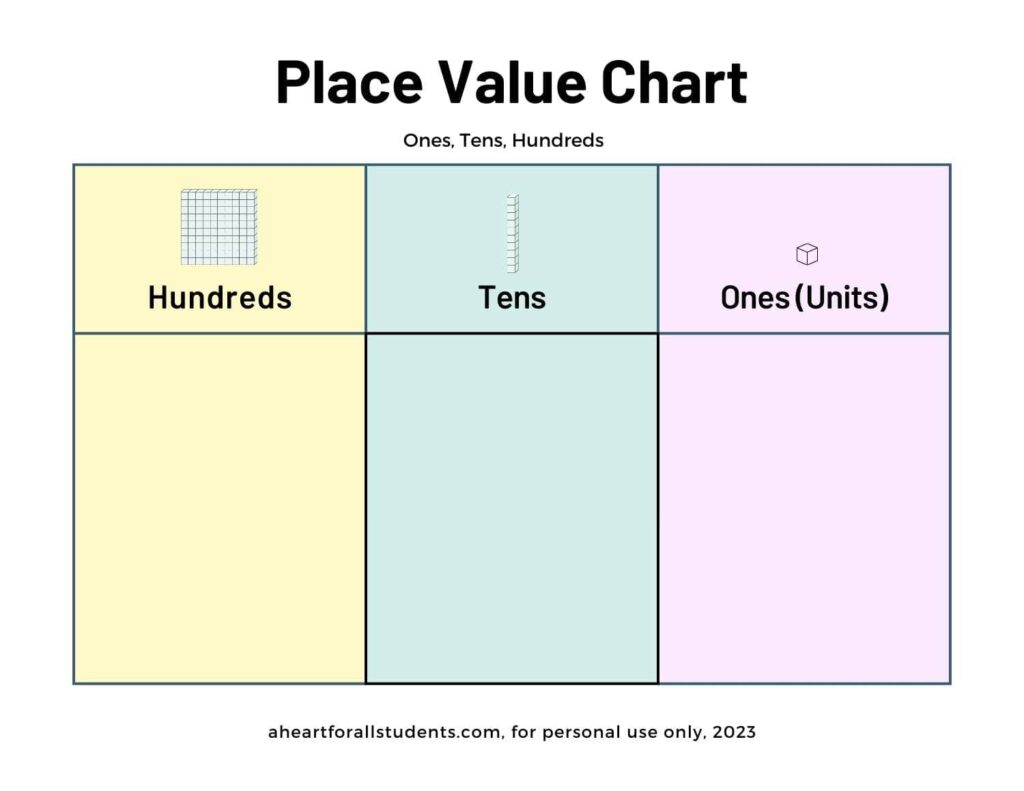
1. Place Value to The Hundreds Place
The first chart is a free place value chart for smaller numbers up to 3 digits. This is the perfect printable for a child beginning their place value education. Each place value column in this printable PDF contains an image of a math manipulative representing that value.

For example, in the…
- “Ones Place” you’ll see an image of a ones cube
- One-unit cube
- “Tens Place” has an image of a tens block
- Representing 10 “ones cubes” stacked upon one another
- “Hundreds Place” shows a figure of a “hundred block”
- Representing 10 “tens blocks” combined to show one hundred.
Use Math Manipulative for Place Value
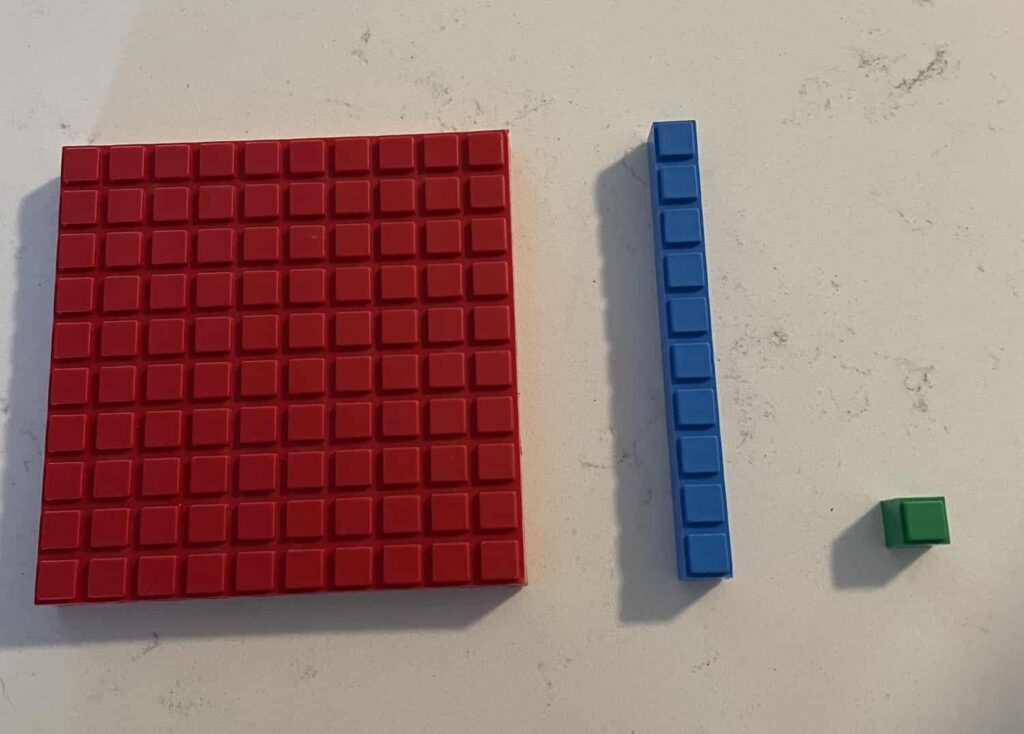
Using real math number block manipulatives is a great way to make math lessons:
- fun
- engaging
- and multisensory.
If you purchase a new set of number blocks, be sure to look for a set with:
- ones blocks,
- tens blocks,
- hundreds blocks, and, if possible,
- at least one thousand cube.
Have your child practice writing numbers by placing each digit in its correct position on the place value chart.
Verbalizing Math Vocabulary
As they write digits in the printable worksheets, have them practice saying the correct number names out loud. Knowing how to correctly identify and verbalize numbers will help students in the long run. When kids struggle with math vocabulary, it impacts later math proficiency.
Don’t underestimate oral language as the valuable learning tool it is. You may want to laminate these place value charts or put them in a sheet protector. Or print one of the next two blank charts as they’re done in different colors. (Personally, I like to save ink, so I print in black and white. However, we’re all different, so you’ve got a few options.)
2. Thousands Place Value Chart
The next place value printable chart is for practicing whole number place values, but is designed for numbers up to the thousands place. Use this for older students from around second grade to fourth grade.
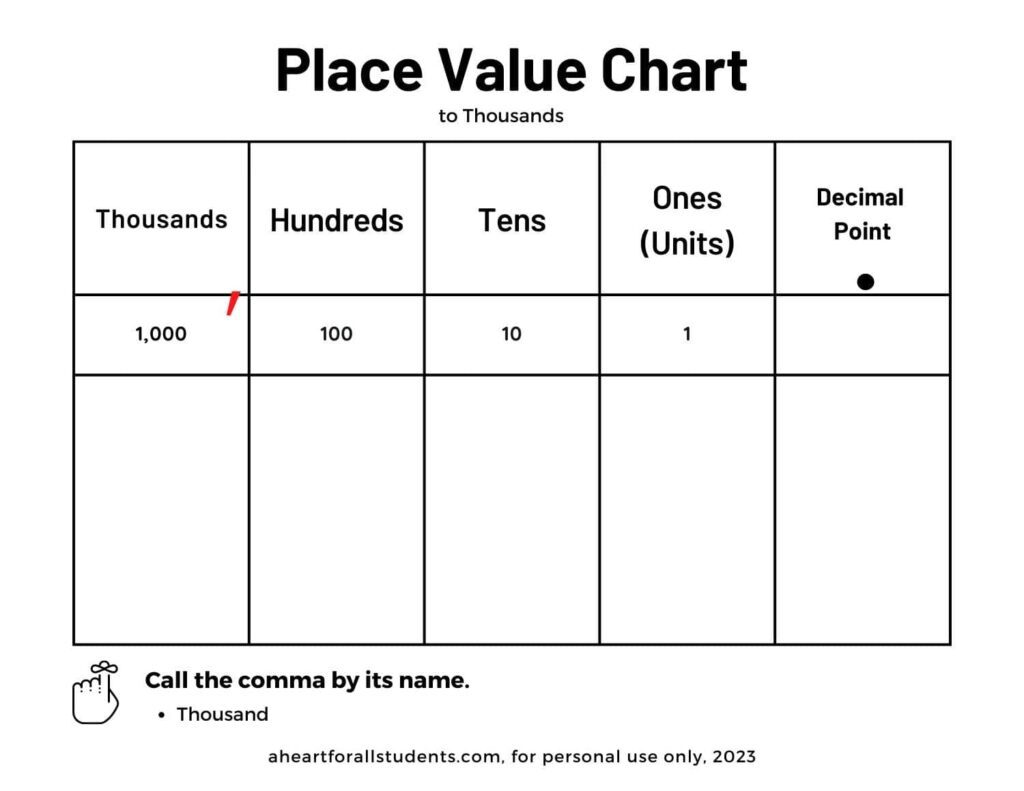
Further, I wanted to get kids into the habit of using the comma in numbers strategically. When writing numbers in standard form, especially larger numbers, it’s helpful to break down numbers into chunks. Let me explain what I mean.
Identifying Number Values Using a Chunking Method
When a child can combine the digits of a three-digit number into one number in word form, it’s easier to verbalize big numbers. For example, let’s look at the number 1645893. It can be overwhelming for the brain to know where to start.
However, when we write a whole number in standard form, we include commas after every 3 digits. I teach students to give each comma a name. The commas are named:
- Thousand,
- Million, or
- Billion
We rarely use numbers greater than that. So, going back to the number 1,645,893, we start by saying the first digit on the far left of the decimal point.

- “One (I point to the comma) Million”
- “Six hundred forty-five (point to the next comma) Thousand”
- ‘Eight hundred ninety-three”
This may seem obvious, but it’s not. So in this thousands chart, I added commas to help with the verbalization and conceptualization of larger numbers.
3. Place Value Printable Chart with Decimal Point
The final place value worksheets are for students who are ready to move on from whole numbers fractions and decimals. Until approximately 2nd grade, as kids develop basic number sense, they typically work only with whole numbers.

However, later they’ll begin learning that whole numbers can be broken into smaller pieces. Specifically, kids learn about fractions and decimal numbers in the later elementary years between 3rd grade and 5th grade.
This printable has space for 9 place value positions and includes those to the right of the decimal. It goes from 1/10,000 (ten-thousandths) to the right of the decimal place all the way to 10,000 to the left.
Related Post:
Numbers and Digits
Now that we’ve looked at the place value printable charts, let’s review the basics of place value. When we write any number, we use a combination of 10 different digits.
- 0
- 1
- 2
- 3
- 4
- 5
- 6
- 7
- 8
- 9
All the different numbers you can imagine are made up of any combination of these ten digits. A digit’s numerical value is based solely on its place value position.
- Small numbers such as 0
- Large numbers such as 9,876,543,210
Same Digits Different Numbers

For example, let’s compare the numbers 294 and 942. If we plug these two different numbers into a blank place value chart, we’ll see that the same digits have different values. Again, those digit values are based on their place value positions.
- In 294,
- 2 has a value of 200 (2 hundreds)
- 9 has a value of 90 (9 tens)
- 4 has a value of 4 (4 ones)
- In 942 (same exact digits)
- 9 has a value of 900 (9 hundreds)
- 4 has a value of 40 (4 tens)
- 2 has a value of 2 (2 ones)
In the end, the most important thing to know is:
- numbers represent quantities
- and are written from any combination of digits 0-9.
Now, let’s move on to place value.
What’s Place Value?
Place value is the basis of our number system. The numerical value of a digit within a given number is shown by its location or “place” within that number. Let’s look at an example.
In the number, 1,645,893, we see the following.
- Seven decimal places (seven different place values) each with its own digit values.
- One digit per place value
- the units place (ones place) (3 ones)
- tens place (9 tens)
- hundreds place (8 hundreds)
- thousands place (5 thousands)
- ten thousands place (4 ten thousands)
- hundred thousand place (6 hundred thousands)
- millions place (1 million)
- 7 total digits within this gigantic number
So, in this case, the number 1,645,893 would be read aloud as,
One million, six hundred forty-five thousand, eight hundred ninety-five.
Notice that you don’t have to read a gigantic number all at once but only up to the hundreds, through the commas. In other words, my eyes focus on the digit before each comma. We’ll be back to this in a minute.
Place Value Games
One way to make learning place value fun is through games.
- Grab a deck of UNO cards or basic playing cards.
- Choose the number of digits you want your student to practice.
- Have your child flip that number of cards over and place them in a horizontal line in front of them.
- Then take the face value of each card and write it down in its corresponding place value position on the place value chart.
- Of course, always have them say the correct numerical value out loud (if possible).
- Model this form them for as long as they need the support
You can use this idea for any level of math. If you’re working with a younger student, practice 2-digit numbers. On the other hand, if you’re working with a more advanced math student, the sky’s the limit.

Base Ten
Our place value system is also referred to as the Base Ten system. The Base Ten place value system is (shocker!) based on units of ten. In Base Ten, each digit on the left side of the decimal point increases in value at a rate of ten times the same digit in the place value position to its right.
Woah. That was a lot to process. So, an easy way to understand this concept is to look at the whole number part of a basic place value chart.

Note that all whole numbers are represented to the left of the decimal point. This place value chart shows the place value of the digits of numbers up to the hundreds place.
Let’s plug in the number 444 as an example. In the number 444, four hundred forty-four, we have the same digit (4) in the three different positional values.
- Hundreds column contains the digit 4.
- Its numerical value is 4-hundreds or 400.
- Tens column contains the digit 4.
- Its numerical value is 4-tens or 40.
- Ones column contains the digit 4.
- Its numerical value is 4-ones (or units) or 4.
The value of the digit 4 changes when in different positions. More specifically, the greatest place value of any digit is the one that’s farthest to the left of the decimal point.
In our chart, 4 hundreds or 400 is the greatest numerical value of the digit 4. (Take your time processing this. This concept isn’t easy for adults, so keep that in mind when working with your child.)
Abstract Concepts and Developmental Level
Young children often aren’t developmentally ready to understand abstract concepts until the age of 12. This means kids are concrete thinkers. They understand the world around them based on what they see, touch, taste, smell, and hear.
While all human beings learn from sensory input, children rely primarily on their five main senses to learn. Because of this, abstract concepts are difficult for younger students to understand.
- Ideas and belief systems are abstract concepts.
- Stuffed animals are concrete (can be physically experienced).
- Value of a digit is an abstract idea
This is why using a place value chart is an excellent way to make the abstract concept of place value concrete.
Brain-Based Teaching Tip
Place value charts, manipulatives, and other math teaching tools help make numbers real. Specifically, they help provide multisensory input to the brain such as:
- Visual
- and tactile input.
Seeing and manipulating digits to make different numbers is fantastic way strenghten this important math skill. Even older kids who understand abstract concepts such as the value of numbers, benefit from multisensory input.

Recap: A Place Value Printable Chart for Your Student
Having a solid grasp of place value is essential to math success. Starting early to help your child build their understanding of the value of each digit in a number is never a bad idea. If the concept doesn’t click with your student, take a deep breath, and pause. Circle back to the idea later.
Remember, place value is an abstract concept that may take years to fully understand. This is to be expected and normal. Download the place value printable chart below.
So, friend. What say you? Any thoughts you want to share about place value or math?
In this together!

Download the Place Value Printable Charts!
Related Posts:
CTC Math Review: Why It Works for ADHD and Autism
The Right Homeschool Curriculum for ADHD Students
9 Best Math Videos for Kids That They’ll Want to Watch
21 Math Strategies Every Homeschool Mom Should Know!
Best Homeschool Math for Struggling Students
The Ultimate Guide: How to Help a Struggling Reader at Home!