
This is part two of a series to help you choose the best homeschool math for your struggling students. In today’s post, we’ll review some of the best homeschool math curricula for kids with learning challenges such as:
- Dyscalculia,
- ADHD,
- Autism,
- Dyslexia
Veteran homeschool moms share their recommendations on the best homeschool math programs for struggling learners. Save yourself that money, stress, and time.

This post may contain affiliate links. As an Amazon Associate, I may earn a nominal fee from qualifying purchases. Thank you for your support. See my disclosure policy for more info.
Homeschooling Struggling Students by Asking the Experts
In today’s post, veteran homeschool moms share their opinions on the best homeschool math for struggling students. We’re using the term “struggling students” to describe:
- ADHD,
- Autism,
- Dyscalculia,
- Dyslexia
Quite frankly, this applies to kids who just plain hate math.
Mastery VS Spiral Homeschool Math Curriculum
There are two different approaches to math curricula out there:
Here’s a brief explanation of the factors to consider when deciding which is best for your student.
What Is Mastery-Based Homeschool Math?
Mastery-based curriculum focuses on one concept at a time. The goal is for the student to master one concept before moving on to the next math skill.
The benefits of a mastery-based approach include:
- Students learn concepts they need to learn.
- They master foundational math skills that carry them through higher-level math.
- Learners are less likely to have math gaps due to repetition and incremental progression
What Is Spiral-Based Homeschool Math?
Spiral-based homeschool math curriculum reviews previously learned material while consistently introducing new concepts. The benefits of a spiral-based math approach are multifaceted and include:
- Provides children with a variety of materials that keep things from getting boring
- Helps support long-term memory and retention of math concepts through review
As you’ll soon find out, both mastery and spiral approaches have their pros and cons. For a deeper dive, read How to Choose the Best Homeschool Math Curriculum: 6 Easy Steps for more.
Top 4 Mastery-Based Homeschool Math
The following list contains the best mastery-based homeschool math for struggling students.
1. Learn Math Fast
No products found.
Beckye Barnes, of Beckye Barnes Consulting, recommends a solid mastery-based homeschool math curriculum, Learn Math Fast.
We have enjoyed Learn Math Fast. It works for all ages, and it starts with the basics. You only move forward once you master the concepts. It’s mastery-based and teaches math concepts without busy work.
Learn Math Fast is an excellent refresher or remedial math program for anyone struggling with math.
No products found.
No products found.
No products found.

Mastery Learning for Struggling Math Students
Additionally, Beckye points to the importance of solidifying foundational math skills.
They also focus on foundational skills in a real world way. Basic addition and subtraction is taught using pennies. Fractions are explained using a dollar and then four quarters. It also focuses on learning the concept without endless worksheets.
Learn Math Fast Is a Dyscalculia Game Changer
Colleen Webster, homeschool mom of 4, (dyslexia and ADHD, dyscalculia, and dysgraphia), also loves Learn Math Fast.
Learn Math Fast was a game changer for my daughter with dysgraphia. LMF breaks the lessons down to make it easier to understand, and they keep it simple.
Dyscalculia & Dysgraphia Impact Homeschool Math
Because Colleen’s daughter has dyscalculia and has tried several math programs over the years.
Learn Math Fast was the first that explained certain concepts in a way she understood.
My daughter felt like she could follow along better with the shorter explanations they gave. She benefited from the break down of each equation into bite size pieces.
2. Life of Fred
No products found.
Life of Fred is a mastery-based math curriculum that’s unconventional, but extremely effective for right-brained kids. It’s a literature-based curriculum that follows the narrative of the main character, Fred.
Fred is a 5-year-old child genius living on a college campus. (Told you it was unconventional.) In the end, each book focuses on one math concept in a highly engaging way.
Foundational Math Skills Through Story
Life of Fred should be read in order regardless of your child’s age. The storyline and concepts build upon one another to provide struggling students with a solid understanding of math.
Consequently, it can be used as a supplement, or as the basis of your entire math program. I recommend it if you have a child who HATES math but loves a story. Bonus, Life of Fred goes all the way up through college-level math including calculus.
No products found.
3. Times Tales- Multiplication Mastery
While Times Tales is not a full math curriculum, it’s an excellent resource to help kids learn math facts. Ultimately, this helps with long-term math success.
Additionally, Times Tales is multisensory and works well for right-brained thinkers. Using mnemonic-based videos, Time Tales creatively gives children what they need to remember math facts for good.
I can’t stress the importance of a solid foundation in basic math facts. Times Tales is a great way to do so.
4. Math U See
What math curriculum does a math professor use in her homeschool? Melanie Fulton, Ph.D., of The Math Profs, loves Math-U-See.
MUS works for us. The lessons aren’t too long–and sometimes we don’t even do a whole lesson in 1 day. The books and worksheets are plain–not tons of pictures or stories to distract.
Notice that Melanie pointed out the clutter-free layout of Math U See. Ultimately, this is extremely helpful for kids who struggle with visual discrimination.
Kinesthetic & Hands-On Learning

Math U See is highly effective for kinesthetic learners who are created with a heightened sense of touch.
Math U See teaches through the tactile sensory system with math manipulatives. Manipulatives include:
- Colored number blocks for each number 0-9
- Colored tens and hundreds blocks
- Fraction overlays
- Decimal insertion kits
As you can tell, this is a solid program.
Spiral-Based Homeschool Math Curricula
The following are four exceptional spiral-based homeschool math programs for struggling students.
1. The Good and The Beautiful for Struggling Learners
Melanie loves The Good and the Beautiful for math for her ADHD kiddo.
Each math lesson different. It keeps it interesting. Honestly, I thought I wouldn’t like it at first because it’s a spiral approach, but now I LOVE it because it’s a spiral approach!
Short Lessons Open the Door to Real Learning
Lessons take 15-20 min max. We’re still learning our basic facts, but we’re also learning time and money while playing games. My kids LOVE it!
Like me, Melanie understands the importance of shorter lessons. This helps her kids push through an entire lesson.
2. Teaching Textbooks: A Spiral-Based Math Program
We love Teaching Textbooks. We’ve been homeschooling for about 8 years. One kid who just doesn’t like math, one with special needs, and one who finds math easy. Teaching Textbooks has worked well for all of them.
Krista, 10 years homeschooling, 3 kids, Girl 17, ADHD, Boy, 15 ASD, G 12 Diva
Spiral-Based Homeschool Math Online Option
Magda Miller has been homeschooling her two kids for more than 10 years.
I second Teaching Textbooks. I have a very self-motivated, math-minded older child. I thought his younger sister might not do as well with it, but I was pleasantly proved wrong.
Teaching Textbooks Works for Homeschool Parents
Magda also points out how nicely Teaching Textbooks supports moms. She loves that it does the teaching and grading. This allows her child to be more independent.
I’m more involved with my younger child’s movement through the program, but it still allows for her to be very independent in her learning and it sticks. She is learning and retaining.
Ma Miller, a homeschool mom of 2 rockstar kids, suspected ADHD, ASD
3. Christian Light: A Solid Homeschool Curriculum
Within my homeschool, we have used many math materials for our ADHD and math-minded family. One of our favorite spiral-based math curricula is Christian Light Math. I like Christian Light for several reasons.
1. Christian Light is broken up into ten work texts for each grade level.
This, in and of itself, is highly motivating to our kids who like to check things off their lists. Every finished work text feels like an accomplishment.
2. It’s thorough and on the advanced side. This is great for your math-minded kids.
3. The program is student-led. All Christian Light materials are designed to be student-led.
As such are visually appealing and broken up into smaller chunks. Each workbook is easy to follow without being overwhelming.
4. The price! Christian Light materials are very affordable.
Pivot Between Mastery & Spiral When Needed
We eventually moved away from Christian Light as the math concepts increased in complexity.
As we neared Algebra, my oldest needed to focus on one concept at a time to best process, retain and develop mastery.
We shifted to a mastery-based curriculum to solidify math concepts to prep her for Algebra.
4. Supplemental Homeschool Math Options
It’s always helpful to have several math tools in your struggling student’s toolbox. Math Minutes is an excellent option.
It’s a workbook designed to hit the most important math concepts in a very concise way. Even more, it’s manageable for kids who dislike math.
No products found.
Math Minutes
There are 10 math problems laid out each day which is a huge plus for kids with ADHD. Each workbook is leveled by grade. While these were created to be supplemental, when used as a math spine, Math Minutes can be an excellent tool.
A math spine refers to a framework to guide your teaching.
No products found.
When my daughter used Math Minutes, any problems she struggled with were the concepts that we could review together. This preserved her limited capacity for math to be used on the concepts that she needed to focus on.
Math Minutes is a great homeschool tool to support math instruction in struggling students.
Calendar Skills for Struggling Math Students
Many neurodivergent children (ADHD or Autism) struggle with abstract concepts such as the calendar. This was certainly the case in my home. Because of this, I created an explicit calendar unit to help my son understand:
- Yesterday, today, tomorrow
- Month
- Day vs date (the number)
- Year
If this resonates, download the free Calendar Unit Study.
Best Online Math Curriculum for Struggling Students
The benefits of using an online math curriculum are numerous. And this can be especially true if your child struggles with math.
Online math provides some of the following benefits:
- Can be modified to your child’s pace
- Visually based for visual learners
- Flexibility
- Less distraction
- and more
So let’s take a brief look at a few online math curriculum programs that can benefit kids with math difficulties including dyscalculia.
1. CTC Math
CTC Math is hands-down the one curriculum I recommend most often to homeschooled students. Two of my three children use it and ask for it every year.
Math is the one subject area that my junior in high school has insisted on continuing independently at home. She’s just finishing Pre-calculus with CTC and will continue to Trigonometry for her senior year.
Benefits of CTC Math:
The benefits of CTC Math include:
- Minimalistic design
- Excellent for distracted ADHD-type learners
- Short to-the-point lessons
- Again, perfect for distracted students
- Lessons at 5-7 minutes MAX
- Grading can be adjusted by parent-teacher to support a positive experience
- No more than 10 practice problems required
- This has so many benefits for discouraged learners
- No timers!! Yay!
- Access to all grade-levels
For more on how to use CTC Math strategically, check out 15 Things to Consider When Choosing Online Curriculum.
2. Khan Academy
Khan Academy is a FREE supplementary online math program designed by Sal Khan. The mission he envisioned when designing Khan Academy was to provide quality free educational resources for all to access.
It offers video-based lessons that focus on specific skills as opposed to grade levels.
Benefits of Khan Academy:
- Video-Based
- Good rate of speech for slow processing speed
- Elementary to College-level math concepts
- Excellent supplemental support
In the end, Khan Academy is a great option to supplement your math curriculum at home. It’s not exciting as stated by my teens (and myself), but it’s a great tool nonetheless.
3. Teaching Textbooks
Many homeschoolers love Teaching Textbooks. Teaching Textbooks is a video-based curriculum that begins in 3rd grade and goes through Pre-Calculus.
Benefits of Teaching Textbooks:
- Clear and concise teaching explanations
- Cartoon-based which is engaging
- Includes ebook textbook
- Minimal teacher involvement
- Good for independent neurodivergent learners
- Grading is done for you
While I prefer CTC Math over Teaching Textbooks for neurodivergent thinkers (ADHD, Autism, Dyscalculia), there are certainly many families who thrive with TT.
4. ST Math
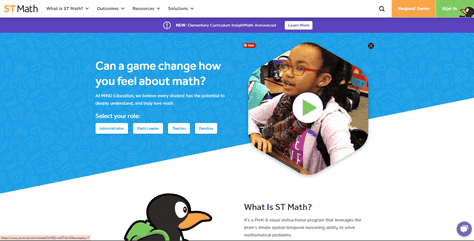
ST Math is a visually-based math program that supports a conceptual understanding of math. It’s an excellent supplemental program that is especially helpful for kids with dyscalculia, FASD, Autism, and ADHD.
Benefits of ST Math:
- Visually-based
- Supports understanding of abstract math concepts
- Brain-based with a focus on Spatial-temporal reasoning
The program is unusual in that there’s no auditory piece. ST Math is completely visual which greatly benefits children with Auditory Processing and Language Processing challenges.
5. Beast Academy Online
Beast Academy Online is the online version of the original graphic novel-based math program. Interestingly enough, the program was originally designed for advanced math students.
While this is still the case, Beast Academy could be an excellent tool for that ADHD learner who struggles with traditional forms of math teaching.
After all, the way a child is taught is often the biggest barrier to learning.
This is why working with your child’s learning style and wiring is essential for learning success.
Benefits of Beast Academy Online:
- Self-paced
- Parent at-a-glance support
- All levels are available at once so kids can go as far as they’d like
- Graphic Novel Based (ebooks in the online program)
- Extremely visually engaging
- Cartoon-based
- Video-based lessons
I recommend taking a look at Beast Academy Online for a student who gets bored easily. Often, choosing a more engaging program like Beast Academy can make a huge difference.
Recap: Best Homeschool Math for Struggling Students
Ultimately, the best homeschool math for your struggling student will be based on several factors.
- Who your child is,
- How your child is wired,
- Your capacity,
- and more
Understanding these things will make all the difference in your curriculum choices.
So, Friend. What is your favorite homeschool math curriculum for your struggling learner?
If you’ve not read Part 1 of this series, please do so. How to Choose the Best Homeschool Math Curriculum: 6 Easy Steps

About the Author:
Lindsay is a trauma-informed educator with a Master’s Degree in Teaching. Her mission is to support moms to equip neurodivergent kids (ADHD, Autism, Dyslexia, Anxiety) to thrive as exactly who they’ve been created to be. Wait until you hear the story that led to it all…
This post may contain affiliate links. As an Amazon Associate, I may earn a nominal fee from qualifying purchases. Thank you for your support. See my disclosure policy for more info.
No products found.
No products found.
No products found.
Homeschooling An ADHD Brain?

Grab FREE ADHD Homeschool Teaching Tips Cheat Sheets!



Loved this! My oldest is autistic so I really appreciate this. Thank you 🙂
Thank you for this helpful post on homeschool math curriculum reviews. I was homeschooled in high school and math was a struggle for me! I now homeschool my own children and can see how using one of these curriculums could be helpful! Thank you for sharing!
Oh my word! Thank you for speaking into this area. It’s so hard to just choose the perfect curriculum when it really all depends on how we think and process the world. Such a blessing that we now have access to so many great programs. Isn’t it amazing how much we learn when we walk alongside our kids? I appreciate your encouragement. 🙂
I just don’t know which one to pick! We’ve been using Time4Learning, but to be honest I’m not sure I like it. There are many math concepts that I myself don’t get, which makes it hard to teach them to my 11 year old twins. They spent up until the pandemic in public school and barely know their times tables, let alone anything else. Plus they get easily bored and we often get tears during math. Can someone recommend the best one for them? I feel like we’re just constantly reviewing with Time4Learning but not really getting anywhere.
Hi Beth, Totally get your frustration and yes… it’s so hard to know which homeschool math is the best one for your specific child. I’d highly recommend you grab the homeschool planning guide in this post and really tease through the questions for each of your children. Even with them being twins, I’d venture to guess that they’re so different and that’s likely the case in learning style as well. One other thing I’d recommend is not worrying about how long things are taking IF they are making progress. Slow progress is still progress and please be assured that it does not take 12 years to learn this stuff. 12 years is an artificial number created to meet the need of a system and not necessarily the need of children. You’re doing a great job! Have you listened to this episode? https://aheartforallstudents.com/home-schooling/homeschool-math-planning-prioritizing-part-2/ I think it will encourage you! You got this, Friend!
Thank you for Parts 1 and 2—both are helpful! My DD with suspected mild-to-moderate dyscalculia had so many foundational math gaps by 6th grade, we used Math Mammoth Blue Series (mastery approach) to fill in the missing pieces. Each section comes with multiple suggestions for online and board/card games, manipulatives, and other helps. Now in 8th grade, she’s made impressive progress. I’m looking into Teaching Textbooks for the rest of Pre-Algebra and moving forward, if only so she can get frequent reviews of previous concepts—as she tends to forget once she moves to something new despite an elephant’s memory in non-math subjects.
CJ, So glad these homeschool math curriculum options were helpful for you. I know how hard it is to see our students struggling and when we’re homeschooling, we definitely feel the pressure. What a blessing that we have so many homeschool resources available though, right? And yes!! I LOVE Math Mammoth as well. We’ve used the Light Blue series and the blue series many times throughout our journey. That reminds me to add some information about the program soon. Thank you for that reminder. So glad your daughter has made so much progress! Definitely check out Teaching Textbooks or CTC Math. We’ve used them as well and they both have great strengths! 🙂
I am sort of at a loss right now. My 5th-grade son did teaching textbooks this year. Just finished it and we started doing some Kahn Academy lessons and I discovered he has forgotten several major concepts and doesn’t even remember doing the lessons on them. We started Beast Academy but he doesn’t like it at all. I don’t know which program will help him learn. He really needs a complete curriculum that can provide the lessons because I can really only be a tutor/resource, not the main teacher.
Grace, I hear you loud and clear. It can be so frustrating when one homeschool math curriculum doesn’t work out. But here’s the thing. No one math curriculum will be perfect. I would recommend you start to think of your ability to tutor your son as EXACTLY what he needs. It’s totally normal for a child to forget some of that which he has previously been taught. Just like adults… we learn something or hear something for the first time, we “get it,” but it’s often not fluent for a long time. It takes repeated exposure to any idea or concept before it becomes automatic. I would recommend you look at a mastery based curriculum for him… something like Math U See may be what he needs. Slow it down and know that he will get it at his pace if we slow down. Beast Academy is more of an advanced curriculum. And I would also mention that video based teaching is often NOT effective for many students (and adults… including me). Paper pencil is often much more effective. Best of luck to you! 🙂 One more thing… it does not take 12 years to learn math. 12 years is an artificial amount of time imposed by a system. Deep breaths… see where he is and take the next step forward. You got this! 🙂
I just finished reading the article on “Best Homeschool Math for Struggling Students,” and it’s a game-changer! As a homeschooling parent, finding the right math curriculum for struggling students can be challenging. This article provides a comprehensive list of effective math programs specifically designed to support and engage struggling learners. I appreciate the detailed reviews and recommendations, which will undoubtedly help me make an informed decision. It’s reassuring to know that there are excellent resources available to ensure a positive math learning experience for every student. Thank you, A Heart for All Students, for this valuable resource!
Oh my… as a mom of a special-needs kiddo (he’s got a laundry list of needs- Fragile X, ASD, ADHD, dyscalculia, dysgraphia, and any other thing you could think of), and on the fence for homeschooling, this article has skyrocketed my confidence! Thank you so SO much for going in depth on how each of these programs can help our special learners! This article is the first one that I’ve read where I can actually narrow down what curriculum may work best for him. Thank you, thank you, thank you!
Kari, Oh, you made me smile. I’m so excited for you! You can totally homeschool your special needs child. Please join the private A Heart for All Students community if you’d like some more support. We’d be honored to have you with us. 🙂