
Neurodiversity-affirming speech therapy is essential to the well-being of autistic children. Why is this important?
The deficit model of autism focuses on changing the characteristics of autism rather than embracing them as a neurological difference. These therapies typically focus solely on changing autistic children and may leave you and your child frustrated.
Today, let’s discuss choosing neurodiversity-affirming speech therapy for your child.
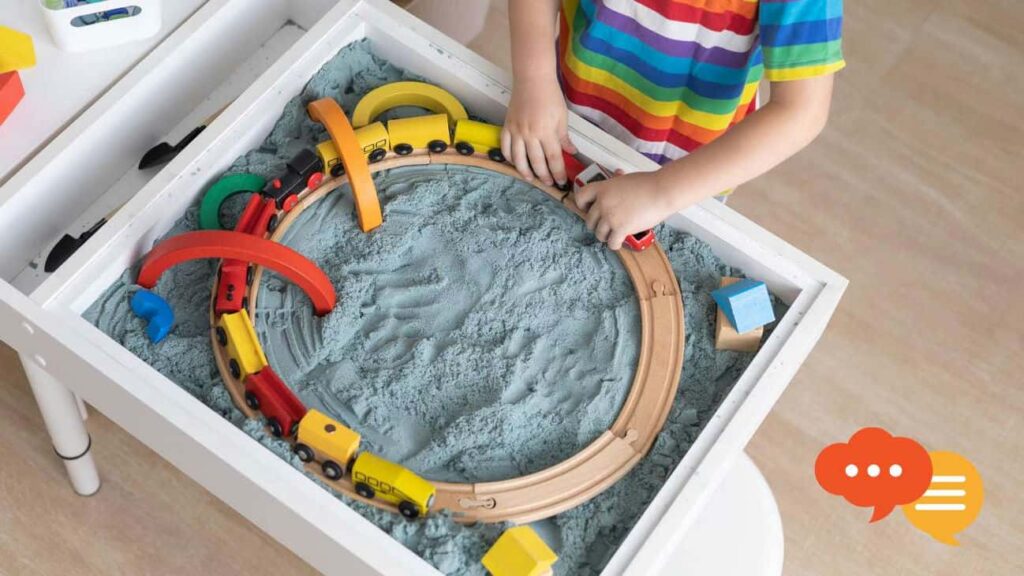
What‘s Neurodiversity-Affirming Therapy?
Neurodiversity-affirming therapy focuses on honoring your child for who they are while providing strategies to help them engage in activities meaningful to their life. Key factors of a neurodiversity-affirming speech therapist include:
- Honoring the lived experiences and voices of autistic individuals,
- Acknowledging that there are two different types of language development each requiring specific strategies to foster language growth
- Gestalt Language Processing
- Analytic Language Processing
- Presuming competence,
- Incorporating special interests into sessions,
- Supporting the child’s sensory needs,
- Valuing all modalities of communication,
- Using a child-led rather than compliance-based approach,
- Encouraging all types of play, etc.
All of this sounds great, but isn’t this how all speech therapists are? Nope. Sadly, some well-meaning speech therapists may cause more harm to your autistic child’s language development.
Question Your Speech Therapist’s Area of Expertise
Speech-language pathologists (SLPs) are considered “experts” in language development. According to the American Speech-Language-Hearing Association (ASHA), SLPs work to prevent and treat language disorders (2023). However, not every SLP is an expert in language development.
According to ASHA, the scope of practice for an SLP includes eight major areas, these include:
- Fluency,
- Speech production,
- Language,
- Cognition,
- Voice,
- Resonance,
- Feeding and swallowing,
- Auditory habilitation/rehabilitation (2016)
But, how can one therapist be considered an “expert” in all these treatment delivery areas? That’s the problem, they can’t be.
Despite four years of undergraduate schooling and two years of graduate studies, no speech therapist can be an “expert” in all areas. Instead, it’s important to consider if your autistic child’s speech therapist is a great fit for them.
Signs of a Neurodiversity-Affirming Speech Therapist
The following includes some signs of a neurodiversity-affirming speech therapist. These qualifiers apply not only to speech therapists, but also to occupational therapists, mental health specialists, and teachers.
1. Honor Lived Experience of Autistic People

A neurodiversity-affirming speech therapist listens to the lived experiences of autistic individuals. Sometimes professionals forget that autistic children grow up and become autistic adults.
Autistic adults often speak out about the harmful practices they’ve experienced in the school system, therapies, ABA, and other settings. This must be honored.
A speech therapist who is not neurodiversity-affirming may not listen to autistic individuals’ viewpoints. Many fall into the trap of using techniques “handed down” from previous supervisors or mentors because it’s “what we have always done.”
2. Knowledge of Gestalt Language Processing
Neurodiversity-affirming speech therapists honor analytic and gestalt language processing as natural ways to acquire language. Unfortunately, many graduate school programs only teach speech pathology students about analytic language development.
Analytic Language Development
Analytic language development follows a “piece by piece” model. This means children learn a word, such as “dog”, and then as their language develops, they can expand upon that word (“dog run” or “brown dog”). With analytic language development, more complete and complex sentences develop later.
Gestalt Language Processing
Contrarily, gestalt language development follows a “whole chunk” language acquisition model. This means children learn language in phrases attached to emotional experiences. For example, here’s a line from the show Peppa Pig that a child may repeat regularly.
Whole to Part Natural Language Acquisition Example

“If you jump in muddy puddles you must wear your boots!”
-Mummy Pig
This Peppa Pig quote is an example “chunk” of language. “Chunks” need to be broken down into individual word parts.
“Boots”
“Wear”
“You”
Once a gestalt language processor “unchunks” individual words, they can then rebuild sentences. At this point, they start to transition from echolalia to self-generated speech. For example, the chunked words above may eventually evolve to the following.
“You wear boots.”
In other words, GLP kids learn language by “echoing” chunks of language from their environment and later transition to self-generated speech.
Uses a Natural Language Acquisition Approach for GLPs
A neurodiversity-affirming therapist will recognize if your child is a GLP. They will then use a Natural Language Acquisition approach to support their language acquisition. For more, check out Gestalt Language Processing: Natural Language Acquisition in Autism.

Speech Strategies to Avoid with Autistic GLPs
A non-affirming speech therapist will likely treat your autistic child as an analytic language processor automatically. Approaches to avoid if you believe your child is a GLP include:
- Core word modeling
- Focusing on one-word models like “go” or “help” with no ties to emotional/meaningful experiences,
- Expansion modeling techniques
- Focusing on increasing the length of your child’s speech output
- For example, adding semantic information to one-word utterances
- Your child says “dog” and the SLP says “Brown dog”,
- Sentence strips
- Teaching rote phrases like “I want ___” or “I see ___” with visuals, etc.
3. Presume Competence
A neurodiversity-affirming speech therapist will presume your child has the skills to succeed. They’ll presume competence even if your child has not “proven” said skills yet.
A great example is when speech therapists introduce augmentative and alternative communication (AAC) devices to clients. A therapist who presumes competence will provide access to high-tech AAC with many icons to start (e.g., 60+ icons on the home screen).
What to Avoid

A speech therapist who is not neurodiversity-affirming may assume that a dynamic, high-tech AAC system with multiple icons is too difficult.
They’ll often start with the Picture Exchange Communication System (PECS). PECS notebooks only allow children to hand an icon to the therapist to request an item. This limits children greatly. Learn more about the Problem with PECS.
4. Incorporates Special Interests
Neurodiversity-affirming speech therapists should use your child’s interests to promote communication and felt-safety in sessions. For example, some GLP autistic children enjoy the alphabet, numbers, shapes, etc.
During a session, a neurodiversity-affirming SLP might incorporate these interests through multiple modalities to promote the exchange of language. For example,
- Letter puzzles
- Magnetic numbers
- Alphabet books
- Favorite stuffed animals
- Toys
What to Avoid
A speech therapist who isn’t neurodiversity-affirming may limit the child’s exposure to these items because they are not seen as “functional vocabulary.” Instead, they may focus on academic concepts, limiting the child’s language development

5. Meets Sensory Needs
A neurodiversity-affirming speech therapist recognizes that children cannot access language until their body is regulated. At the BEGINNING of the session, they should provide the necessary accommodations for them to be successful.
This could look like:
- Having the child sit on a wobble chair,
- Hold a fidget,
- Swing on an indoor swing,
- Do an obstacle course, etc.
A non-neurodiversity-affirming SLP may treat sensory tools as a reward to be earned after the child has accomplished their presented tasks. This is not ok and limits the child’s ability to learn.
5. Value All Communication Modalities
A neurodiversity-affirming speech therapist honors ALL forms of communication. These include:
- Gestures,
- Facial expressions,
- Mouth words,
- Signs,
- Written language,
- AAC, etc.
This means they don’t treat any communication modality as better or worse than the other.
Ultimately, the end goal of neurodiversity-affirming speech therapy will not always be that your child will speak using mouth words. Instead, the goal is to support your child in the modalities that meet their unique communication needs.
6. Honors Body Autonomy
A neurodiversity-affirming speech therapist should always honor your autistic child’s body autonomy. This means that physical prompting like hand-over-hand is not used.
A non-neurodiversity-affirming SLP may take a client’s hand and force them to use their AAC device. This may be because the therapist feels they need to “teach” the child how to use their device.
Instead, speech therapists should model using the device without expectation. They then should provide consistent exposure to language modeling throughout the session.
7. Child-led Approach

The neuro-affirming speech therapist should NOT push their agenda on the child. Rather, they should use a child-led approach. A child-led approach in speech therapy means that the child’s interests, desires, and preferences are the priority.
A neurodiversity-affirming speech therapist can target the child’s therapy goals with ANY activity. An emotionally regulated child engaging in play will make more progress than they would if forced to complete non-preferred activities. Remember, interest increases dopamine which supports attention and learning.
What to Avoid
A non-neurodiversity-affirming speech therapist may use compliance-based techniques. Compliance-based techniques may include:
- Bribery with food items,
- Sticker charts,
- Withholding desired toys or sensory supports until a task has been completed
These techniques focus on external rewards rather than intrinsically motivating activities.
8. Encourages All Types of Play
A neurodiversity-affirming speech therapist honors all forms of play. If your child likes to line up toys or animal figures for the entire session, they are free to do so. They acknowledge that there is no “right way” to play. Play is honored as what makes the child happy and keeps their nervous system regulated.
A non-neurodiversity-affirming speech therapist may force the child to play with new toys every session. They may withhold desired toys to “expand interests,” or disrupt the child’s play as a “communication opportunity.”
3 Toy-Rule
Neurodiversity-affirming SLP, Alexandria Zachos of Meaningful Speach, emphasizes the importance of the “3 toy rule.”
This means presenting two familiar and one unfamiliar toy throughout the session. Doing so allows the child to explore a new toy if interested, but it doesn’t force them. Instead, they have familiar toys to play with no matter what.
Recap: Neurodiversity-Affirming Speech Therapy
Choosing a neurodiversity-affirming speech therapist for your autistic child is an important goal to support their long-term well-being. When looking for a neuro-affirming therapist, consider those who value:
- Learning from autistic individuals,
- Expertise in Gestalt Language Processing,
- Up to 80% of autistic people are GLPs
- Presuming competence,
- Prioritizing your child’s special interests,
- Supporting sensory needs,
- Valuing all modalities of communication,
- Using a child-led rather than compliance-based approach,
- Encouraging all types of play, etc.
Choosing a neurodiversity-affirming speech therapist will help reduce stress and support greater learning. Does your child have a neurodiversity-affirming speech therapist?
Sydney Montero, M.S., CCC/SLP
graduated with her Master of Science in Communication Sciences and Disorders from the University of North Dakota. She is licensed by the board of North Carolina and has her Certificate of Clinical Competence (CCC) from the American Speech Language Hearing Association (ASHA). She’s passionate about neurodiversity-affirming child-led care for her clients. sydney@speakingsensory.com