
We’ve been collecting alphabet toys and play-based phonics tools for years. Teaching my oldest kids to read was relatively smooth.
Despite a hard journey with our youngest, when he turned 5, I looked forward to teaching him to read. He was obsessed with the alphabet since he was 2-years-old. I assumed that would be a HUGE advantage.
Here comes the but…
He has always been pretty demand-avoidant. In other words, he has no interest in “formal” (mom-imposed) learning. Because of this, I had to be very strategic in my approach. Like, bend-over backward creative. Maybe you can relate?

Got Kids Who Don’t Want to Learn? Find Fun Tools
If you have a child who’s demand-avoidant, save yourself some heartache. I’ve got you.
Today I’m sharing some of the most engaging play-based phonics tools that we’ve used in our homeschool.
And if you’re a parent looking for fun ways to engage a younger child in play-based learning, this post will be helpful as well.
This post may contain affiliate links. As an Amazon Associate, I may earn a nominal fee from qualifying purchases. Thank you for your support. See my disclosure policy for more info.
Engagement Is Key In Learning
Each of the following play-based phonics tools supports language, spelling, and reading skills in fun and engaging ways.
In the end, remember that engagement and internal motivation are essential when it comes to learning. Nothing beats it.
7 Play-Based Phonics Resources to Use at Home
The following are 7 play-based phonics resources to use with your young learner!
1. Leap Frog’s Letter Factory
Let me start with the classic. The Leap Frog Letter Factory series. This is educational screen time at its best. No guilt over this screen time. Promise.
I found this series 15 years ago when teaching my oldest to read. She’d hit a wall in her motivation to learn (probably because she was too young to have mommy pressuring her into academics).
I remember that a veteran homeschool mom wisely told me that it was time to “back off” my child.
“She’s so young. Give her a break and make learning fun.”
She was right. One of her suggestions was the Leap Frog Series. My girls loved them. So, when my son came around years later, it was a no-brainer to use them again.
How To Use Leap Frog’s Learning Video Series
No products found.
This Leap Frog video series originally began with the Letter Factory. I recommend you start with that one first because:
- It lays a solid foundation in the basic consonant sounds.
- Additionally, it includes all the short vowel (CVC words) sounds.
Once your child is solid with basic letter sounds (phonemes), I recommend moving on to the next in the series.
2. The Talking Words Factory
No products found.
The Talking Words Factory teaches children that when letters are paired in different combinations, they make different sounds.
Specifically, The Talking Words Factory introduces:
- Simple word building:
- CVC words (consonant-vowel-consonant)
- cat, rat, sat, hop, jet, set
- CVC words (consonant-vowel-consonant)
- Initial blends (st, cl, bl)
- Silent e words
Once your child is ready for the next video, move on to The Word Caper.
3. The Word Caper
No products found.
I love these Leap Frog videos because they lay a solid foundation for reading and spelling.
Once you’ve explored The Letter Factory and The Talking Words Factory, move on to The Word Caper.
It moves beyond the basic letter sounds and simple word building to teaching vowel teams and digraphs.
- Long vowel sounds or vowel teams
- For example:
- ea in leap
- oa in boat
- For example:
- Simple Digraphs
- Two or more letters that make a unique sound when combined
- sh, th, ch, tch
- Two or more letters that make a unique sound when combined
Leap Frog Letter Factory For ADHD and Autism
Leap Frog’s target audience is preschoolers. However, they’re worthwhile learning tools for older kids with special needs or those who need extra support.
For example, among other things, my son has a very significant speech and language processing delay.
We’ve been using Leap Frog with him since he was 2. At that time, the series gave him a strong interest in letters and their sounds.
Older Kids Can Benefit From Leap Frog
At times, when homeschool reading curriculum doesn’t work for my son, we circle back to these videos.
To that end, we’re now using them as an instrumental tool to develop his reading and writing skills. Ultimately, these can be used for any child who needs to strengthen their basic reading skills.
In the end, age doesn’t matter. Always focus on the next step in your child’s educational journey.
That next step is always based on YOUR child’s needs and NOT artificial benchmarks.

Play-Based Phonics with Leap Frog
All three Leap Frog videos provide a multisensory approach to learning.
Using multiple areas of the brain to receive and process information is key to retaining new information. The Leap Frog series provides this multisensory experience!
Multisensory Play-Based Phonics
- Visual Input
- The use of imagery allows kids to learn phonics information visually.
- The use of imagery allows kids to learn phonics information visually.
- Auditory Input with a Focus on Rhythm
- Song and rhythmic chants hit the musical and auditory areas of the brain.
- Song and rhythmic chants hit the musical and auditory areas of the brain.
- Kinesthetic
- If your kiddo is anything like mine, the dancing alone will support long-term memory.
The Leap Frog Series has since expanded its series to include more subjects. Specifically, these include numbers, shapes, vowel-teams, digraphs, and more.
The storylines engage and support your child’s early learning. Fortunately, a lot of these Leap Frog videos are available for FREE on Youtube.
4. Melissa & Doug See & Spell Wooden Puzzle
No products found.
I love this see and spell wooden puzzle set from Melissa and Doug.
It contains multiple small double-sided puzzles each with a simple spelling word. Children use the right combination of the 64 wooden consonants and vowels to spell the word on the board.
See and Spell Toy Lesson Ideas
There are 16 different puzzle boards to see and spell.
- Say the phonics sounds aloud and have your child choose and stick the correct letters to spell words;
- Spell your child’s name on a large piece of paper. Then have him identify the letters (visual), peel them (kinesthetic), and stick them on top of the hand-written letters.
- Have your kiddo choose his own words to stick and spell.
These stickers peel easily without ripping making these a great choice for littles needing fine motor skill practice.
5. Melissa and Doug Letter & Number Stamps
When he was into trains, we spelled the names of the Thomas & Friends trains.
This Melissa and Doug resource can withstand the beatings that come from being used by young kids.
No products found.
My son loves using the stamps to “spell” his name and the names of our family members.
I also like these stamps because the set includes basic punctuation marks and numbers.
Alphabet Wooden Stamps Lesson Ideas
This tool can be used for years and in many ways. For example,
- Say phonics sounds aloud and have your child choose and stamp the correct letters to spell words;
- Spell your child’s name on a large piece of paper.
- Then have them identify the letters (visual), and stamp them on top of the hand-written letters.
- Have your kiddo choose their own words to stamp and spell.
The number stamps are an added bonus for early math activities.
Fine Motor Skills & Phonics Tools
Use your child’s interests to drive learning.
- Practice Letter Name Identification
- Practice Letter Sound to Letter Symbol Correspondence
- Word Building by Copying
- Spelling By Sound (once simple sounds are mastered)
- Number Recognition
If you’re doing preschool at home, these activities are another way to improve fine motor skills.
6. All About Learning Pre-Reading
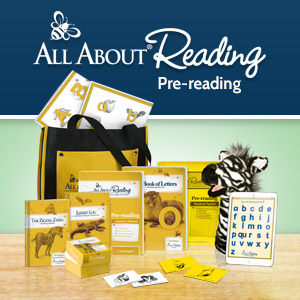
When your child is ready for formal reading instruction (don’t rush), another great resource is All About Learning Press.
This company supports phonics, reading, and spelling using the Orton Gillingham method of instruction.
The program is created with the homeschool teacher in mind, so there’s never a need to worry about “not being a teacher.”
Any parent can pick up this program and confidently teach reading and spelling.
RELATED POST: Orton-Gillingham Method & All About Reading
7. Magnetic Letters & Storage Box
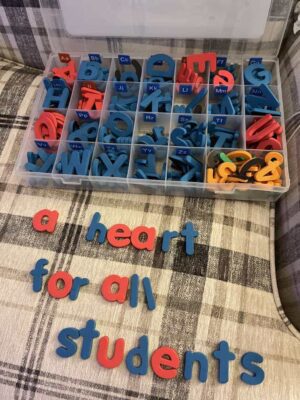
My son loves this magnetic letter set. It’s perfect because it comes in an easy-to-organize storage case.
Further, it identifies consonants and vowels in different colors.
- Consonants are blue
- Vowels are red
Additionally, there are a few Uppercase letters included for every letter. To be honest, my son used these letters in play while watching the Leap Frog series.
This increased his engagement and his retention of all the alphabet sounds.
Recap: Play-Based Phonics Tools
What about you, Friend? What play-based phonics tools and activities do you and your kiddos enjoy?
Do you find it challenging to get your child interested in learning? Would love to hear from you!
Does your child struggle to remember?
What they’ve read? Multi-step directions?
What you asked them to do 5 min ago?
If so, take the Homeschool Teacher Training to help!
- Auditory Processing vs Language Processing
- How they impact literacy, communication & behavior
- What you can do to change the trajectory of your child’s future by addressing underlying issues!


I homeschooled my kids for a few grades and I have to admit that my biggest moment was teaching them to read too! So I commend you that huge milestone! Thanks for sharing. These are super essential!
You are a rockstar momma, Nicole!!! I appreciate your encouragement!!