
Closed syllable words are the most frequent words young readers encounter. This is why mastering them is often the first step to successful reading and spelling.
So today, let’s touch on the closed syllable type, discuss what it is, and why your student will benefit from mastering it. Then, grab the closed syllable word list to use as an anchor chart for your homeschool or classroom.

This post may contain affiliate links. As an Amazon Associate, I may earn a nominal fee from qualifying purchases. Thank you for your support. See my disclosure policy for more info.
What is a Syllable?
Teaching children to read and write is an important assignment for a homeschool mom or classroom teacher. When children have a solid understanding of syllable types, it makes learning to read and spell so much easier.
But, what exactly is a syllable?
A syllable is a part of a word that contains a vowel. When speaking, we refer to the spoken syllable. Each spoken syllable is centered on a single vowel sound. Meaning, that each syllable has one vowel sound.
Counting Syllables Develops Strong Readers
You can count the number of syllables in a word by placing your hand on your jaw. As you pronounce a word, your jaw drops every time you voice a vowel sound (if the pronunciation of a word is correct).
For example, let’s look at the word CLOSET.
- If you place your hand on your chin, you’ll notice a subtle drop of the chin for each of the two syllables.
While many adults automatically “hear” syllables, this is not an automatic skill. The ability to identify syllables is one of several critical phonological awareness skills.
Six Syllable Types
Closed syllables are just one syllable type in the English language. There are six syllable types.
- Open syllable
- Closed syllable
- Consonant-le
- Vowel Teams
- Magic e (or silent e)
- Bossy r (R controlled vowels)
Let’s take a brief moment to review these six types of syllables.
1. Closed Syllables (CVC Words)
Closed syllables are the most common syllable type and contain one vowel that makes a short vowel sound. It’s closed in by a consonant that follows it. For example,
- Cat
- The Vowel A is voiced as a Soft A sound because the consonant T closes it in as the last letter of the syllable

When teaching a child to read using a phonics approach, the closed syllable is the first syllable type introduced.
Specifically, in phonics, we introduce children to one-syllable words with a CVC pattern (consonant-vowel-consonant). Other examples of one syllable closed syllable words include:
- sat
- mat
- hat
- Sam
- ram
Each one of these CVC words is made of one syllable. However, like open-syllable words, closed syllables are also part of multi-syllable words. For example,
- Campus
- Pumpkin
- Uplift
- Submit
Recap: Closed syllable words have one vowel that makes a short sound and is followed by a consonant.
2. Open Syllable
An open syllable has a long vowel sound at the end of the syllable.
Further, you can see this because the syllable is open. Specifically, there is no consonant following the vowel in the syllable.

Examples of closed syllables include one-syllable words such as:
- He
- She
- A
- We
- Hi
Some multisyllabic words with open syllables include the following:
- Apron (the first syllable is “a”, the second syllable is “pron”)
- Robot
- Make learning open syllables a multi-sensory learning experience with this Robot Puppet Template.
- Cola
- Polo
Recap: Open syllables have one vowel that makes a long sound. It’s described as open because there is no consonant sound following it.
3. Magic e or Silent e Words
The next syllable type is the Magic E (Silent e) and it produces a long vowel sound. Magic E words are spelled in the VCe pattern (Vowel-Consonant-Magic E).
- Cake
- Bake
- Hope
Two-syllable words with the Magic E vowel sound are often compound words.
- Cupcake
- Hopeful
- Sunshine
When referring to Magic E words, many of us grew up using the jingle, “Silent e makes the first vowel say its name.”
Recap: In Magic E words, words are spelled in the VCe pattern, and the first vowel produces a long vowel sound.
4. Vowel Teams

Vowel teams are 2 or more vowels that when combined, make a unique single unit of sound. These are typically long vowel sounds, but at times, can have a short vowel sound.
Long vowel sound vowel teams include:
- ea (read, leap)
- ai (pail, rail)
- ee (deep, peep)
Some multi-syllable words with vowel team syllables include:
- Raisin
- Reason
- Explain
- Monkey
- In this case, the Y is acting as a vowel in the vowel team -EY.
- Monday
- Again, Y is part of the vowel team -AY.
- Both -EY and -AY endings are found a the end of a word.
Less Frequent Short Vowel Sounds
In rare cases, vowel teams create a short vowel sound. For example, the word READ can be read with a long or short vowel sound.
Recap: Vowel teams are two or more vowels that, when combined, make a unique vowel sound (most often long).
5. R-Controlled Vowel Syllables
Another type of syllable in English words is those with an R-controlled syllable (or a Vowel-R syllable). Examples include:
- Car
- Fir
- Nurse
- Purse
- Worth
Vowel-R syllables are often more challenging to master for a number of reasons. One reason is that the “r” sound is often one of the last sounds to articulate clearly when spoken.
Additionally, three of the Vowel-R syllables make the same sound: er, ir, and ur.
Recap: R-controlled syllables, a vowel is followed by an R. This creates a unique vowel sound. (Example: -ar, -or, -ir)
6. Consonant + le
The last syllable type is the Consonant + le syllable. This syllable type is often referred to as the “final stable syllable” and we find this at the end of the word.
Examples include:
- Stable
- Cable
- Title
- Dazzle
It’s important to note that these “end of word” syllables do not make a true vowel sound. However, the sound is always the same and follows the consonant-le pattern.
Recap: Consonant + le syllables are remembered as the final stable syllables (no true vowel sound).
Download the Free Closed Syllable Word List!

Syllable Division Rules
It’s helpful for students to become familiar with these spelling patterns and syllable division rules. When children can recognize spelling patterns, they’re better able to navigate unfamiliar words.
This is because these syllable rules are demonstrated throughout the English language. If kids can identify part of a word based on familiarity with the six syllables, they’re at a real advantage.
Of course, we do have quite a few irregular words and those are often taught as sight words. Here are some kindergarten sight words in case you need them.
Orton-Gillingham
The best way to teach reading and spelling is to use a systematic, step-by-step, phonics-based method. Orton-Gillingham is a method originally designed to support struggling readers, such as those with dyslexia.
However, we now know that this system of instruction is effective for most learners. Fortunately, several reading and spelling programs use this methodology.
All About Reading & All About Spelling
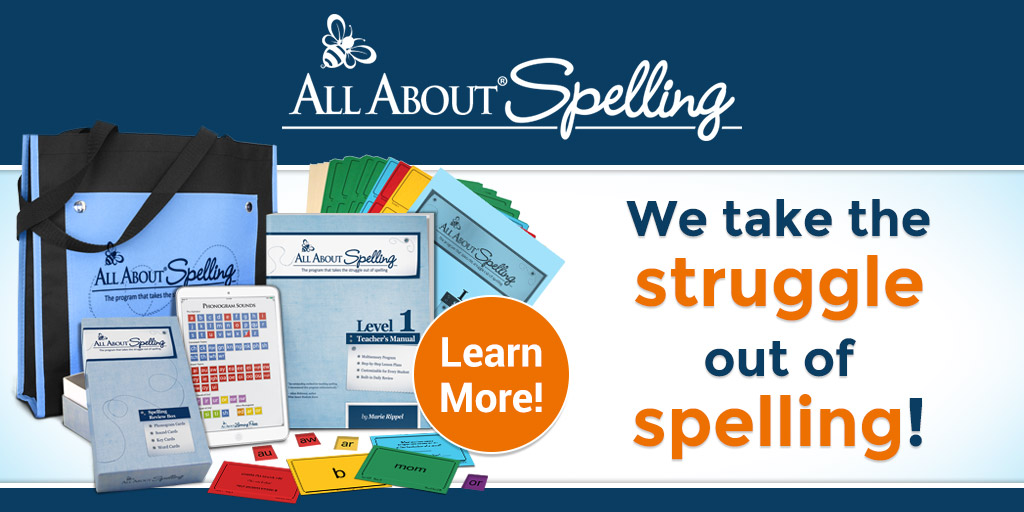
For example, All About Reading is a reading program that provides kids with lots of closed syllable practice. All About Spelling is the corresponding spelling program.
Both of these highly recommended homeschool programs use an image of a closed door to represent closed syllables. Likewise, they use an image of an open door for open syllable words with a long vowel sound.
Like all Orton-Gillingham programs, All About Reading and All About Spelling offer a multi-sensory approach to learning.
Visual Cues Can Help Your Reading Students
Specifically, All About Reading uses color-coded letter tiles to represent different phonemes or letter sounds.
- Blue letter tiles represent consonants
- Red letter tiles represent vowels and vowel teams
- Purple tiles represent the three sounds of -er (-er, ur, ir)
- Yellow letter tiles represent the other Bossy R controlled sounds (-ar and -or, for example)
We began using All About Spelling in our homeschool more than a decade ago, and I can’t speak more highly of the program.
It’s filled with a myriad of fun different activities to teach children word attack skills.
Phonological Awareness
Whether in kindergarten, first grade, or older, children learning to read need plenty of time to develop their phonological awareness. Again, phonological awareness refers to the overarching ability to isolate and manipulate parts of spoken words.
The ability to identify syllables within spoken words is a foundational phonological awareness skill. Other phonological awareness skills include:
- Rhyming
- Identifying the number of words within a spoken sentence
- Phonemic Awareness:
- The ability to identify and manipulate individual sounds within and to make words.
Because closed syllable words are the most frequently used in the English language, young students need lots of practice with them.
How to Teach Closed Syllable Words?
You can teach your child about closed syllable words in a variety of ways. I’ve created a word list of 85 closed syllable words to help your child’s developing language skills.
Print out the closed syllable word list and use it in a variety of different learning activities.
- Use magnetic letters to do word work.
- Choose a close syllable rime and have your student blend with a variety of onsets
- Onset refers to the initial sound before the vowel in a syllable.
- Rime refers to the vowel and any letters that follow
- For example, in the word MAT, the onset is M- and the rime is -AT
- Choose a close syllable rime and have your student blend with a variety of onsets
- Closed Syllable Word Hunts:
- When reading books with and to your student, give them a magnifying glass and have them go on a closed syllable hunt.
Make it even more fun.

Nonsense Closed Syllable Words
You don’t have to use real words to practice closed syllables. Create nonsense words by adding unusual beginning sounds with your closed syllables.
For example, ZAT, BLAT, BRIG. The sillier the better. As your student progresses, add consonant clusters to create more complex different words.
For example, in the word CLAP,
- the initial onset is a consonant blend CL-
- and the rime is -AP.
Recap: Closed Syllable Words
Mastering closed syllable words is an excellent first step when teaching kids to read and spell.
Further, closed syllable words that produce a short vowel sound are the most frequent words early readers will tackle.
Kids should have many opportunities to practice reading these words in both decodable readers, word lists, and other word-play activities.
Download the free closed syllable word list to use in your homeschool or classroom.
And, if you need more phonological awareness activities for kindergarten, first grade, or early readers, check out these resources.
- 15 Ways to Teach Rhyming Words to Kindergarten & Older
- 33 Best Rhyming Picture Books for Kindergarten & More
- Best Reading Curriculum for Kindergarten & Beyond
So, friend. Did I miss anything? Comment below.
In this together!

Download the Free Closed Syllable Word List!

About the Author:
Lindsay is a trauma-informed educator with a Master’s Degree in Teaching. Her mission is to support moms to equip neurodivergent kids (ADHD, Autism, Dyslexia, Anxiety) to thrive as exactly who they’ve been created to be. Wait until you hear the story that led to it all…
Does your child struggle to remember?
What they’ve read? Multi-step directions?
What you asked them to do 5 min ago?
If so, take the Homeschool Teacher Training to help!
- Auditory Processing vs Language Processing
- How they impact literacy, communication & behavior
- What you can do to change the trajectory of your child’s future by addressing underlying issues!