
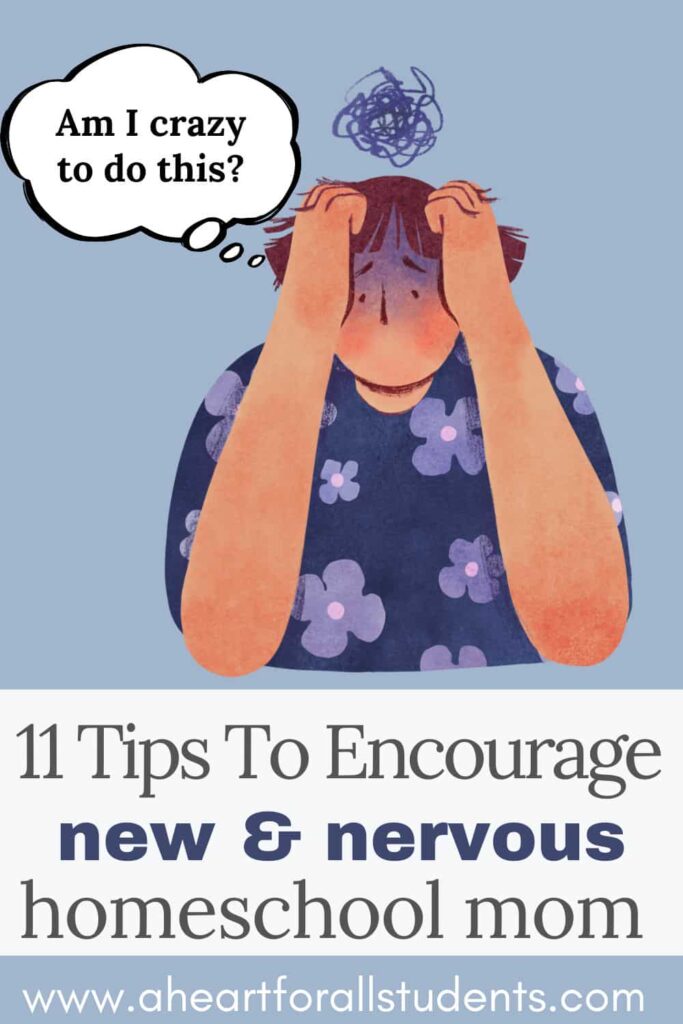
Homeschool tips for beginners. Each fall, parents everywhere start homeschooling for the very first time. And sadly, many feel anxious because they mistakenly believe they aren’t qualified to teach their children.
If you feel scared about homeschooling, please take a deep breath. As an educator myself, I know you can do this. Today I’m sharing 11 homeschool tips for beginners (or veterans who need encouragement).
Pin me!
This post may contain affiliate links. As an Amazon Associate, I may earn a nominal fee from qualifying purchases. Thank you for your support. See my disclosure policy for more info.
11 Homeschool Tips for Beginners
The following are my top 11 homeschool tips for beginners. May they encourage you to go for it, Friend!
1. Dare to be Different
If you’re new to or considering homeschooling, you may be worried at night.
Can I do this?
Yes, you can do this. I promise.
We’re all just people doing our best with what we know at any given time. When it comes to what’s best for your child, trust your gut. My first homeschool tip for beginners is to permit yourself to be different.
It’s ok to make decisions that are different from your neighbor, best friend, or pastor’s wife. There is no right or wrong.
2. Expect to Feel Insecure
I’ve homeschooled long enough to know that any mom who has the desire can do this. However, that doesn’t mean there won’t be times when you will doubt your decision. This is normal and to be expected. I feel insecure at times. That’s part of parenting.
Just face it now. You will become overwhelmed and insecure.
You’re doing something outside your comfort zone. When the insecurity creeps in, pray and reach out to your homeschool mom community.
3. Get Yourself Community ASAP
I should have written this one down first. The most important of these homeschool tips for beginners is this. Find YOUR homeschool mom community. Every homeschool parent NEEDS support.
Just do it.
I’ve been homeschooling so long that I forget that some people think it’s unconventional. I have a ton of homeschool friends and community. But what if you don’t know ANYONE who homeschools?
Don’t panic. Here are a few easy strategies to start building your homeschool community.
How to Find Homeschool Friends
- Join a local Facebook Homeschool group
- On Facebook, go to the search tool and type in your town and homeschool. You’ll find something.
- Join AHFAS Facebook Group
- Our online community has a ton of homeschool moms from all over the world. We’ll help you get set up!
- Reach out to local churches, libraries, or your town hall to help connect you with the homeschoolers in your area.
4. One-on-One Support

Back to the insecurity thing. Yep. Feeling fear about homeschooling is a real thing. Let’s think about this logically.
Parent support with homework and reading is a strong indicator of student academic success.
Why?
One-on-one teaching time is extremely effective and efficient. When a supportive adult is available to offer insight, check for understanding, and encourage, children thrive. You can do this.
Related Post:
5. You Don’t Have to Be an Expert Teacher
But I am not a teacher. How can I teach math and science?
You do not have to be an expert on anything to homeschool well.
Can you read? Then you can learn and facilitate learning.
Learn With Your Child in Your Homeschool
Co-learn alongside your child.
There’s an overabundance of homeschool curricula out there. And this is good stuff because homeschool curriculum is made with the parent-teacher in mind.
Don’t start off purchasing homeschool curriculum made for the traditional school system. Rather, look for programs made for homeschool parent-teachers. And then enjoy the process of learning with your child.
Grab my homeschool curriculum planning guide to help.
6. Follow Your Child’s Interests When Homeschooling
Partner with your child. Dig into topics of interest.
- Read books.
- Engage in discussion
- Ask questions
Dialogue is key. Process aloud with your child.
Conversation activates areas of the brain that are not employed through passive listening. When we stop to ask our kids their thoughts and listen, we model respect for them as thinkers. More importantly, we demonstrate that we value their ideas.
That alone increases motivation and child engagement. This, my friend, leads to discovery-based learning.
Need simple conversation starters to get your child processing language with you? Try this list of this or that questions for kids.
Pin Me!

7. Learn & Observe
Go on nature walks and explore creation together. Be intentional about using your ability to “be still and observe.”
Homeschooling with nature study is an excellent way to employ discovery-based learning. Check out this nature scavenger hunt or one of these other learning resources to guide you in nature study.
No products found.
No products found.
No products found.
8. Don’t Look at the Clock
There is no way I can do this! I don’t have time.
Before you start panicking about the time it takes to homeschool, let me help. Homeschooling is NOT school at home. Homeschooling is time efficient.
Think about it this way. How much one-on-one teaching time does a child typically receive in a traditional classroom?
Maybe 5 minutes if they’re lucky, right?
Just a few minutes of focused one-on-one teaching at home can equal an entire class period. (Circle back to homeschool tip #4. When an adult is there to catch mistakes, issues are addressed on the spot.)
Learning Doesn’t Take 7 Hours A Day
Public schools are within a system.
The traditional school day is filled with time-intensive extras that have nothing to do with learning.
These are systematic time-suckers that don’t apply to homeschooling.
- Lining up,
- Roll call,
- Moving from one class to the next,
- Reviewing problems that only meet the needs of a few in the class,
- Fire drills, etc.
Ultimately, what takes 7 hours in an institutionalized system can often be accomplished in just a couple of hours at home. Stick with short lessons.
Save Time, Stress, and Cash with The FREE Homeschool Curriculum Planning Guide!

9. Have a Designated Space but Don’t
While having a designated learning area is a good idea, there’s a lot of flexibility with that.
I’ve set up multiple “homeschool classrooms” in my home throughout the years. None of them worked for everyone.
Kitchen Table or Trampoline
When your kids are younger, you’ll need to be more active in their lessons. The kitchen table was an easy place to do lessons when my kids were young. However, a lot of our best learning happens:
- On the trampoline
- In the living room on the floor
- My kids’ bedrooms
- (typically the older ones)
- While driving in the car
- (car schooling is a real thing)
- At a local park or library
Central Curriculum & Supply Station
All of our homeschool curricula are located in one central location. While doing schoolwork, the kids park themselves where they’re most efficient.
Typically, my teen girls do most of their work in their bedrooms at their desks. My son… he’s in the kitchen with me.
You do what works for you in this season. You’ll end up tweaking it as your journey progresses and your needs change.
You’re in Charge
Ultimately, there are no rules about when and where learning takes place. When homeschooling, everyone is aware of what is being learned throughout the week. As such, natural conversations and connections are made even on a Saturday.
10. Freedom to Choose Makes the Difference

Homeschooling allows you to choose what works best for your unique family.
In crisis schooling back in 2020, parents were told what, when, and how to homeschool their kids. I’d lose my mind if someone tried to tell me what curricula, timeline, and plan to use with my kids.
Literally, with no insight into:
- My child’s wiring, strengths & interests,
- Time capacity,
- Parent-child dynamics,
- Needs of siblings,
- My teaching and learning style, etc…
I could go on and on. Parents, teachers, and kids were set up for failure.
When homeschooling, you create the plan based on the unique needs of your child and family dynamic. There are many homeschool methods to choose from so pick what works for you and your family.
This will make all the difference.
11. Focus on the Goal: Learning
We all know why education is important. So, when homeschooling, you must focus on the goal. Ask yourself,
What do I want for my child in the long run?
Most likely, the answer is that you want your child to learn and know how to learn. Read good books, take your kids outdoors, explore with intention, and follow your child’s interests.
You can do this!
Recap: 11 Tips for Homeschool Beginners
If you want this for your child, you can homeschool. You don’t need a fancy diploma on your wall to give your child an incredible education as a homeschooling beginner.
In fact, those of us with education backgrounds often struggle those first few years trying to replicate school at home.
Don’t fall into the trap. It’s not worth it. You got this!

About the Author:
Lindsay is a trauma-informed educator with a Master’s Degree in Teaching. Her mission is to support moms to equip neurodivergent kids (ADHD, Autism, Dyslexia, Anxiety) to thrive as exactly who they’ve been created to be. Wait until you hear the story that led to it all…
Save Time, Stress, and Cash with The FREE Homeschool Curriculum Planning Guide!
How To Choose the Best Homeschool Curriculum?
If you’ve been looking at homeschool curriculum for the fall, you’re in luck. Check out this post for help.
In it, I survey homeschool moms and ask them to share their favorite homeschool language arts programs.
1. Master Books
Melissa Cochran, M.Ed., is a former principal, reading specialist, and kindergarten teacher. She homeschools 2 teens with Autism and anxiety.
She loves Master Books.
Master Books curriculum is open-and-go. The curriculum is written to the student and is easy for new homeschoolers to jump into without feeling overwhelmed.
To continue to the #2 recommended homeschool language arts curriculum, continue reading here.
Related:
The Right Homeschool Curriculum for ADHD Students
Homeschooling ADHD: 29 Useful Tips to Save Your Sanity
My ADHD Homeschool Supply List: 27 Must-Haves for Your Homeschool!
My Child Hates Writing: 27 Tips to Help Reluctant Writers
Orton Gillingham Approach and All About Reading- Why They Work!
Never Stop Learning: Homeschool Parent Trainings
For in-depth support, check out the series of homeschool parent trainings.
- The Unregulated Child: Sensory Systems & Self-Regulation in Your Home & Homeschool
- Homeschooling The Distracted Child: Optimizing the ADHD Brain For Learning
- Huh? How Language Processing Impacts Reading, Writing & Relationships
This post may contain affiliate links. As an Amazon Associate, I may earn a nominal fee from qualifying purchases. Thank you for your support. See my disclosure policy for more info.


Excellent motivational post to inspire those who are afraid to homeschool. There are so many resources and support groups who can help to lighten the load.
Thank you, Kimberlie! Absolutely!! There is a whole world of homeschoolers out there and it is a thriving community with a never-ending supply of support and resources. I agree. 🙂
I’m going to share this with my friends who are choosing to home school this year. So many people are doing it for the first time. This is a great resource!
Thank you, Kate! I appreciate your support! 🙂
Thanks for inspiring us. We are indeed in a crazy yet ‘can be productive’ situation. I am a teacher and a mom, and my kids are homeschooling too for the first time. I am juggling my responsibilities as a parent and a teacher. But, I do this with a heart so, things will be managed smoothly.
Thanks, Karen, for your response. Girl, we mommas are in this together. All just doing the best we can for our kids. Thanks for all you do! 🙂
Great read!! Thanks for sharing such a great blog, blog like these will surely helpnew homeschoolers in homeschooling their children in best way.
Thanks, Ashley! Thats’s the goal. Appreciate your encouraging words. 🙂
Hi Lindsay, thank you for this post 😉 Blessings
Glad you found these homeschool tips helpful! Thank you for the kind words. 🙂
Thank you for this – great tips without a lot of waffle!
Great read!!! Thanks for sharing such a great blog, blog like these will surely help each and every homeschooler in homeschooling their children in best way.
It’s a really awesome article with such handy content. I love such articles that contain out of box content.