
How do you discipline bad behavior?!! The tantrums and meltdowns are killing you. You’ve tried every approach and nothing works to end your child’s explosions.
Girl, I get it!!
Parenting isn’t easy for anyone. However, when your child has ADHD, Autism, or another neurodivergence, it’s difficult to know how to discipline.
You know your child has different needs.
- sensory processing challenges
- anxiety
- speech and language delays
- processing challenges
Pin me!

So when the tantrums and meltdowns start, what do you do? Especially, when traditional parenting approaches only make things worse?
Friend, I spent years figuring this out and today, I’ve got something for you!
Guess what?
Disciplining bad behavior well has nothing to do with traditional punishment, discipline, or consequences.
So, if you’re ready to find relief from your child’s explosive behaviors, let’s get to it.
This post may contain affiliate links. As an Amazon Associate, I may earn a nominal fee from qualifying purchases. Thank you for your support. See my disclosure policy for more info.
How I Discipline for Bad Behavior
Today, I’m sharing how I discipline “bad” behavior. Then, you’ll see a video where I walk through how I disciplined my son’s “bad” behavior meltdowns.
I use the term “bad” in quotes to demonstrate that most of the time, there’s nothing “bad” about it.
- meltdowns
- tantrums
- opposition
- explosions
In the end, there’s always a reason behind behavior. We’ll get into that more later too.
Traditional Discipline, Consequences, & Punishment Fail
Everyone tells you to nip it in the bud.
There must be consequences or he’ll never learn.
The parenting approaches you’ve been taught tell you that your child needs hard-core discipline. Maybe a good spanking or at least a time-out?
Ugh! You know that’s not going to work with your kid. And you want to scream! (Or is that just me?)
If you’re a Christian, there’s a greater problem.
How do you reconcile traditional Christian parenting approaches, and the damage that those discipline strategies cause?
Especially if your child has a known neurodivergence such as ADHD or Autism?
(And even if your child is “neurotypical,” when your kid doesn’t fit the mold, the punishment approach often does more damage than good.)
Ultimately, you’re overwhelmed, humiliated (especially if it happens in public), and at your wit’s end.
Related Post:
Help Rather Than Punish
Recently, I posted an idea pin on Pinterest.
(Are you following me there?)
It showed a video of my son and I having a pillow fight. The thing is that just a few minutes before, he’d been:
- screaming
- “throwing a tantrum”
- melting down
- and was out of control.
It was a full-blown meltdown, and I was so freaking tired.
Like you, I was tired of all the bad behaviors, the tantrums, the screaming. And I’m sure I needed a nap!
Earlier in my parenting journey, I would have used traditional discipline strategies such as:
- “No, Sir!”
- “Go to your room!”
- Time-Out
- Loss of a privilege
However, I now know that my kid was not giving me a hard time. He was having a hard time.
That meant that he needed me to help him rather than punish him.
What’s a Meltdown?
Wait, let’s back up a sec. What exactly is a meltdown?
The term meltdowns is most often associated with ADHD, Autism, and sensory processing challenges.
However, everyone has meltdowns at times. Adults included.
According to dictionary.com, meltdowns are defined as:
A sudden loss of control over one’s feelings or behavior.
Traditional discipline and punishment mindsets consider “out-of-control” behaviors as willful. However, they’re most often not.
As adult women, we simply need to think about how we “lose it” on our kids. We scream, yell, or worse, and then we instantly feel regret.
Sensory Issues Aren’t Just Kid Issues
We didn’t mean to lash out. Instead, we became overwhelmed with the chaos and stimulation all around us.
Chaos and stimulation is code for sensory overwhelm.
- Sensory Issues
- Noise (kids are too loud, the TV is blaring)
- Physical Touch (kids crowding around you, hanging on you)
- Interoception (you need to pee, and you haven’t eaten all day)
As a human being, you only have so much capacity. You are not God. I’m not God.
So, we lose it and have a meltdown because we can only handle so much.
Shame Doesn’t Make Behavior Better
The last thing you and I need when we meltdown is to have someone we love shame us. Could you imagine your husband or a friend saying this?
No, Maam! You’re out of control. Go to your room until you can behave.
If you heard that after “behaving badly,” just imagine the shame and humiliation you’d feel.
Plus, at that moment, you’d likely “lose it” more on that judgmental person.
Your relationship would likely take a big hit and that’s not good. In the end, you wouldn’t feel as safe in that relationship.
It would be very difficult for you to take direction from that person.
Well, this is what happens to children when we use traditional parenting strategies to discipline or punish the “bad behavior” out of them.
Related Resource
Episode 29: Christian Discipline for ADHD & Autism- The Strategy That Will Change Everything!
“Disciplining” Bad Behavior Means to Teach
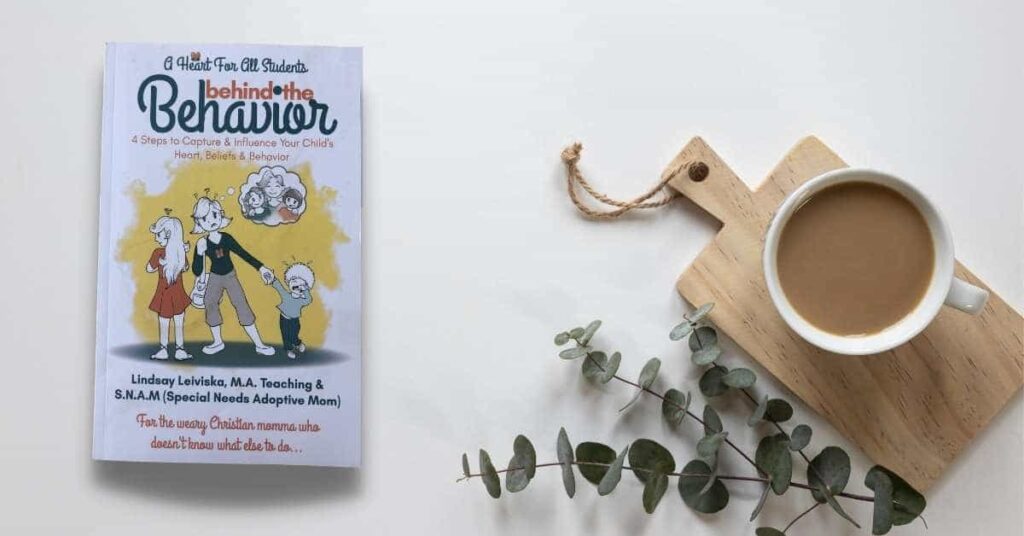
In my book, Behind the Behavior, I share my own parenting journey. Here’s an excerpt about what I’ve learned about discipline.
According to Merriam-Webster, the word DISCIPLINE comes from the Latin word DISCIPULUS which means: “student.”
The number one goal of discipline isn’t punishment in order to produce a desired behavior in children. The goal of parenting is to raise emotionally healthy, functioning adults.
Lindsay Leiviska, pp.24-25, Behind the Behavior
In the book, I share how at the root of discipline is the heart of a teacher.
If you’re a Christian, we see Jesus’ disciples (there’s that root again) being taught by Jesus in safe relationship.
Because of this, I’ve learned to focus on the long-term well-being of my kids. That means that I focus on equipping them with what they need to thrive in adulthood.
Learn More in Behind the Behavior Book!
Watch the Messages We Send to Kids
Proverbs 12:18 cautions us to watch our words. I believe whole-heartedly that this translates to the words and messages we send our kids.
The words of the reckless pierce like swords, but the tongue of the wise brings healing.
This means that our children’s mental health (internal dialogue) matters. In the end, the messages kids hear in childhood are the ones they take with them into adulthood.
When I’m disciplining bad behavior, I lean into the question.
- What message do I want my child to receive in this moment?
I’m not perfect at it, but keeping this question in my mind guides me to discipline focused on relationship first.
Jesus influences me through safe relationship. Without a safe relationship with my kids, I have no influence.
Behavior is communication. When your child is melting down (regardless of age), pause and look Behind the Behavior.
4-Steps to “Discipline” Bad Behavior
As someone who loves Jesus, I believe the Gospel calls me to influence my children through a safe relationship.
And this is foundational to the 4-step framework of discipline that I lean into when my children “behave badly.”
- Relationship (Connection)
- Emotional Vocabulary
- Appropriate Touch (Sensory Input)
- Shifting Attention
You can learn more about this entire framework in the Free 5-day Parenting Devotional or in the book Behind the Behavior.
Meltdowns Pushing You to Your Limit?

Free 5-Day Parenting Devotional for Relief & Tools That Work!
Pillow Fights Beat Punishment
In this video, you’ll see why I chose a pillow fight in response to my son’s meltdown and tantrum.
Specifically, you learn why I chose connection and sensory input to discipline my son through his “bad behavior”.
By offering him connection, he felt safe. He knew I was in his corner.
Additionally, connecting through play helped in the following ways.
- I knew it would help him shift his attention off of the stress he was feeling.
- The pillow fight provided him with proprioceptive input that calms the body and brain by releasing serotonin.
- The playful nature of the activitiy connected us which created a sense of safety for him.
- That connection gave him ears to “hear me”
So, Friend. Now it’s your turn. Watch the pillow fight vs punishment video and let me know what you think.
What Do You Think?
How can you use connection, play, and appropriate sensory input to calm your child when they’re having a meltdown?
What “bad behaviors” does your child struggle with?
Tantrums? Meltdowns? Overwhelm? Anxiety?
Let’s chat in the comments below. We’re in this together!
And to dive deeply into this framework of parenting, check out the free 5-Day Parenting Devotional Series for Relief & Tools that Work!
Meltdowns Pushing You to Your Limit?
Free 5-Day Parenting Devotional for Relief & Tools That Work!
Learn More in Behind the Behavior Book!

These are great tips!